Mark Schniepp July 2026
Clarifying AI’s notions of Today’s Economic Issues
Last February, I asked Perplexity to list the most pressing economic issues facing the nation. The AI executes a massive and timely scan of the myriad issues addressed by major newspapers and blogs, to develop what I expect to be both timely and relevant.
Fast forward 5 months and I asked Perplexity to update the request. The current list identified today is not much different from February. My response to the list however is less accepting, especially regarding the details. Here are the big 4 that the AI listed:
- Consumer affordability and inflation
- The Economic Impact of Artificial Intelligence
- Global Tariffs and Trade Policies
- The National Debt and Fiscal Policy
This is generally what people will see when they ask their AI about current economic issues. My immediate response is that the tariff and trade policy concern is no longer an issue and is off the table. Why? Because U.S. exports are at an all-time record high, and imports are rising again and will likely eclipse their previous record value by the end of the calendar year.
The tariff threat originally generated widespread fear, uncertainty and predictions of dire consequences last year. Imports prior to tariff adoption soared and then contracted. The data show little to no ongoing impact by tariffs after the rates across countries stabilized.
The AI still wants to consider tariffs as a threat to both inflation and a possible restriction on trade. I don’t think so. Perplexity: D.
Affordability and Inflation
Affordability remains problematic and will continue to be a pressing issue especially in California. Recent inflation is due to the war. However, directionally, inflation is likely to abate, albeit slowly. Crude oil prices have dropped precipitously and as of July 3, are now at $68 a barrel. Average gasoline prices nationwide have tumbled, from $4.56 in late May to $3.75 on July 3. In California, prices have not declined proportionately, falling to $5.34 today from a peak of $6.15 in early May.
Price of Regular Grade Gasoline
U.S. and California
January 3, 2026 – July 3, 2026
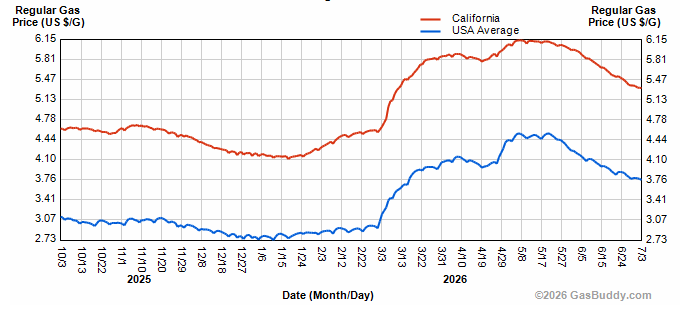
Look for gasoline prices to continue their downward movement and the monthly inflation reports to show a contracting albeit slower rate of price change over the next several months. Much of the increase in fuel prices has been baked into too many goods and services for that price pressure to be relieved anytime soon. Consequently, inflation reports will unlikely revert back to the mid 2s this year.
The scourge of the dreadful levels of inflation that characterized 2022 and persisted through 2023 seriously impacted consumers and left them scarred and resentful. This is why the consumer sentiment indices from the University of Michigan remain at recession level lows regarding optimism about the economy.
I give Perplexity an A on this issue because it ended its explanation with this summary:
The most likely path is gradual disinflation, not a clean break lower. In other words, prices probably keep rising more slowly than in the peak inflation period, but the year ends with inflation still above target and with some month-to-month volatility.
National Debt
Perplexity summarized as follows:
The national debt is a real concern. Current projections still show large deficits ahead, which means the problem is not resolving on its own. Because it can raise borrowing costs, slow growth, and reduce the government’s flexibility, even if it does not trigger an immediate crisis.
The national Debt and fiscal policy issue has been an ongoing concern for years and though the extent of the debt continues to broaden (which the AI correctly reported), there is both acknowledgement and some movement under the current Administration to downsize government. Federal employment has declined to its lowest level since May 1966. Non-defense discretionary spending cuts and meaningful reductions in international aid payments along with investigations of fraud and corruption associated with government spending programs are at the forefront of the administration’s current efforts.
If Congress was more willing to cut codified spending programs and adopt a balanced budget, interest rates would respond by contracting, and likely across the yield curve. Finally, tariff revenue could ultimately become a key revenue source over time that would pay for some of our overspending.
Perplexity: B
AI and the Labor Markets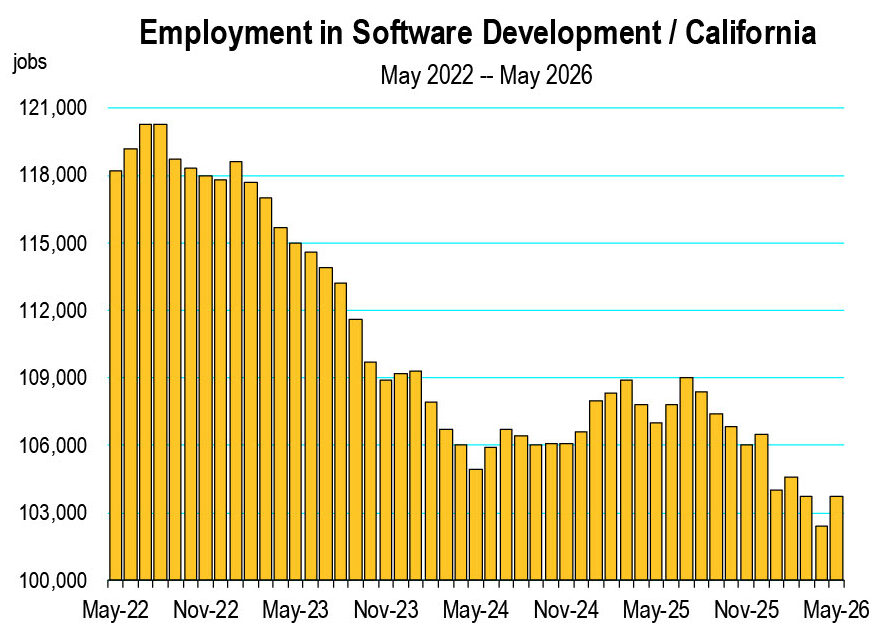
The story of AI and the labor markets has been the principal issue I’ve addressed frequently in these newsletters over the last 18 months. The employment by industry data clearly show declines in the obvious sectors where AI is being adopted. No reversal has been detected yet and I’m not optimistic that it will.
The U.S. Census Bureau’s Business Trends and Outlook Survey found that in 2023, 3 to 6 percent of employer businesses were using AI, with the percentage rising by several percentage points within months of the first report.
From December 2025 to May 2026, the same Census survey found that 17 to 20 percent of businesses reported using AI, and that 20 to 23 percent expected to be using AI within six months. By May 2026, 37 percent of firms with over 250 workers and 32 percent of companies with 100 to 249 workers reported AI usage.
Many other surveys present similar rates of AI utilization by business, or higher use. Adoption has clearly widened over time, from single digit use in the early 2020s to twenty percent or higher today.
Large and mid-sized employers are far more likely to use AI-approximately a third more small firms. And clearly, reducing their large human workforces has been a meaningful consequence of this adoption.
Perplexity’s bottom line on AI and the labor market:
Right now, AI is more of a labor market reshaper than a mass unemployment machine, but the risk of localized job losses—especially for junior white-collar workers—is real and already visible. Whether it creates more jobs than it destroys will depend on how fast firms adopt it.
This is true but the AI is being more diplomatic than candid. There is already growing adoption and that trajectory is not slowing down. Perplexity: C+
Summary
AI can discover and report on economic issues that it finds are more frequently addressed in online blogs, newspapers, white papers, press releases, and videos. However, it has a difficult time filtering through arguments not based on the most recent data. Tariffs are not much of an issue anymore. Inflation remains an issue but the endpoint to me is more predictable than AI is able to report.
The national debt is a longer-term problem that while concerning today, has little immediate impact on today’s economy, other than keeping interest rates elevated, the extent to which AI has little to say about. Forces are underway to reverse the debt but meaningful success over the next year or two is doubtful given current bottlenecks in Congress. Nevertheless, some progress is underway.
The workforce is vulnerable to AI replacement. Period. Whether this reverses with meaningful numbers of jobs created to support and assist AI implementation and enhanced usage has yet to be supported by actual evidence, and by only hope.
The California Economic Forecast is an economic consulting firm that produces commentary and analysis on the U.S. and California economies. The firm specializes in economic forecasts and economic impact studies, and is available to make timely, compelling, informative and entertaining economic presentations to large or small groups.