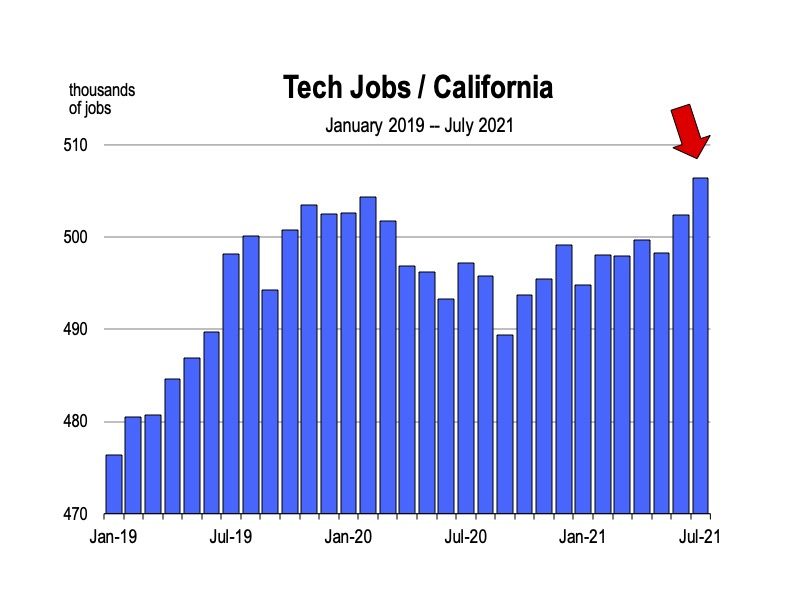
The U.S. Economy Comes Roaring Back and California Reopens

by Mark Schniepp
April 8, 2021

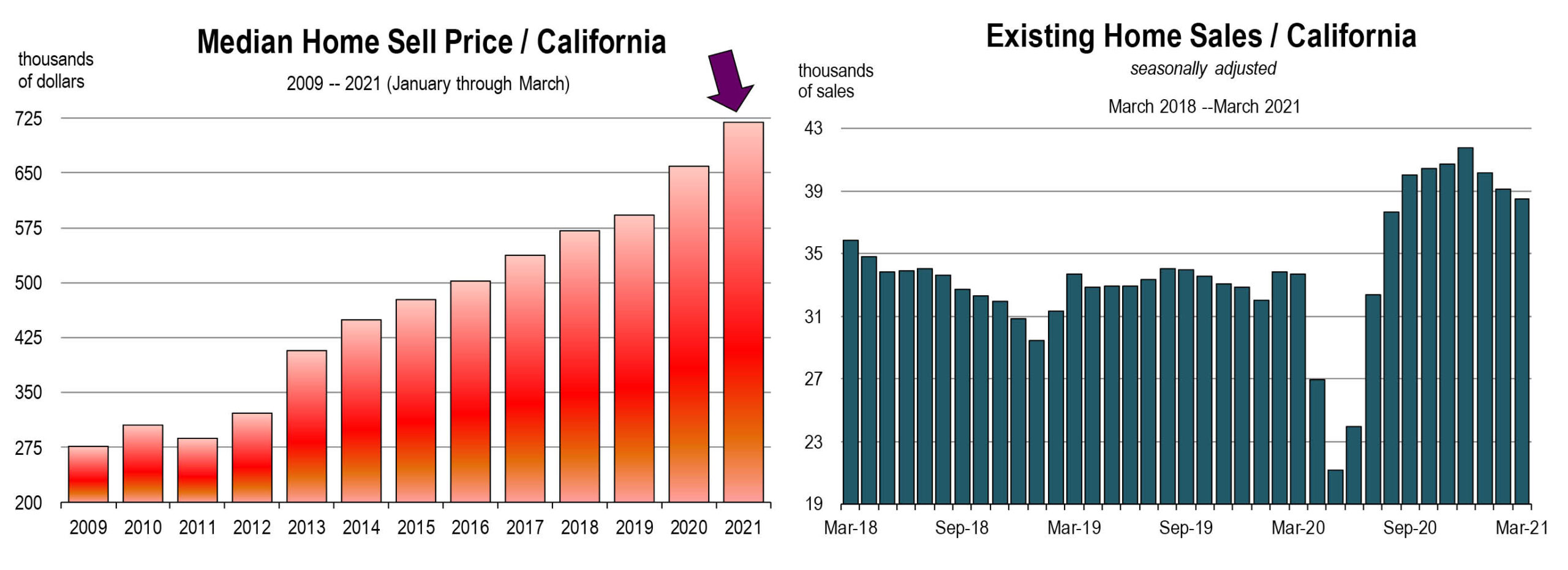
With the advent of spring the U.S. economy is clearly strengthening and is further along than nearly every other big economy in the world. Nationwide, the economic recovery has gained new momentum with a collection of economic indicators recording some of their highest values since the pandemic began a year ago.

Attribute all of this to the precipitous decline in positive case counts, the complete or near-complete opening up of large states like Texas, Arizona, and Minnesota, and gradual relaxation of restrictions in other states.

The stock market remains at or near record levels of valuation. The S&P 500 index set another record high on April 8, 2021. The Nasdaq is only 200 points from it’s all time record high.

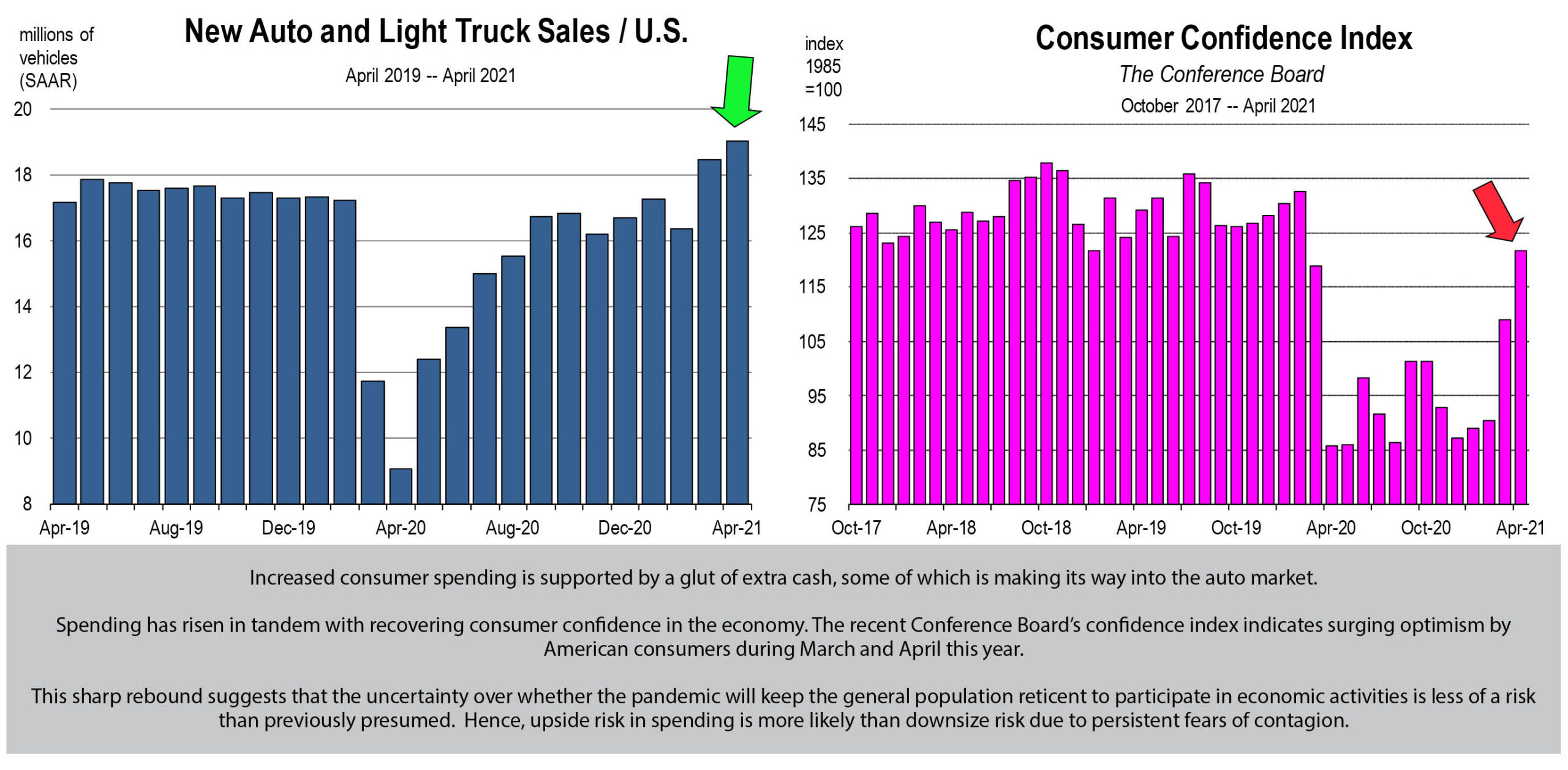
Consumer perceptions of their job and income prospects this year have now risen to their highest level in 13 months. As confidence rises, this normally also leads to increased spending and job opportunities.

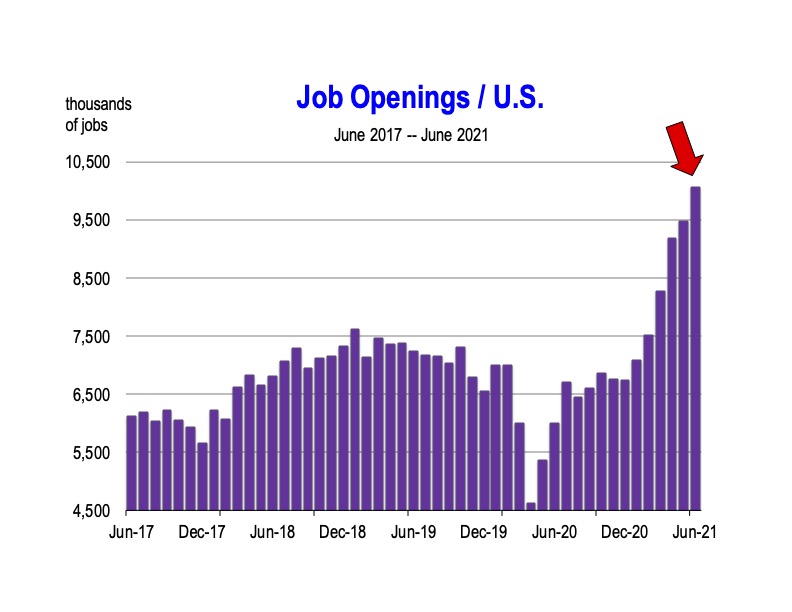
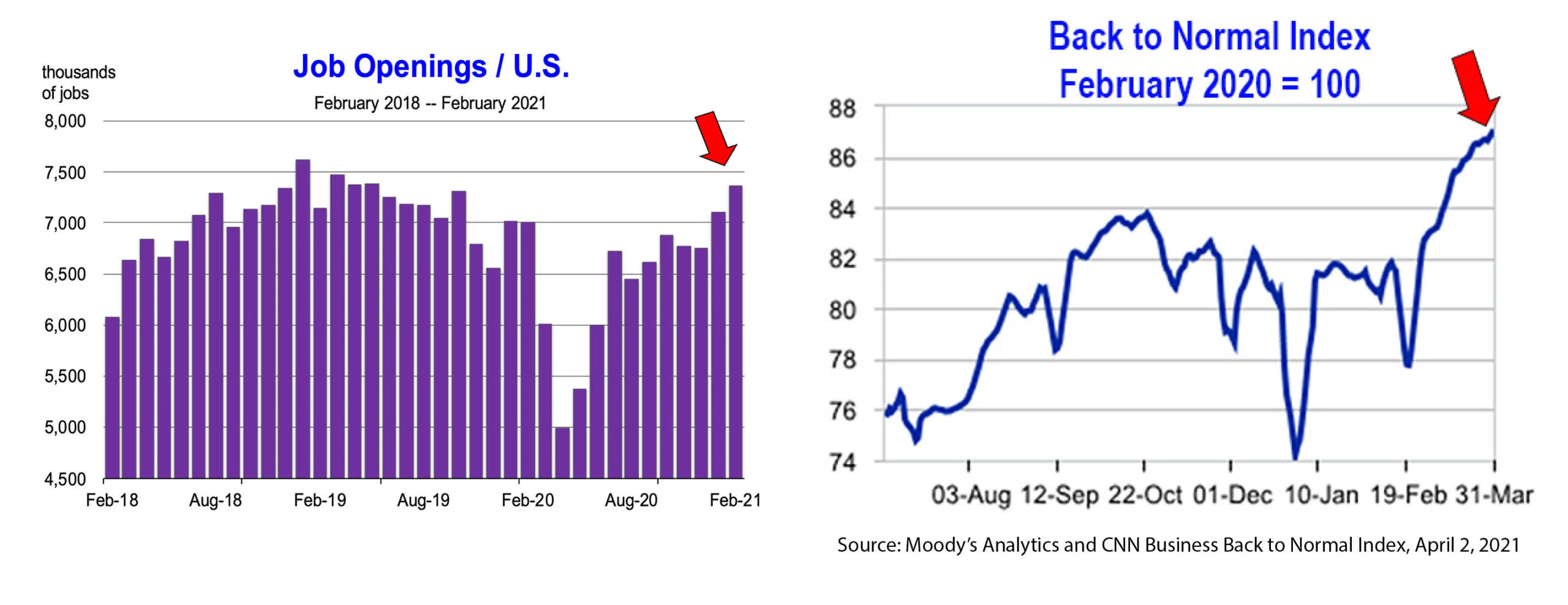
Sure enough, job openings increased to their highest level in two years and the sales of vehicles soared in March, to the highest level since 2017.

Manufacturing surged in March, to it’s highest level since the 1980s!

Loosening COVID-19 restrictions on the economy unleased 916,000 new jobs in March. Rapidly then, the labor market is bouncing back and this indicator alone will give way to substantial increases in new spending, accelerating general economic growth.

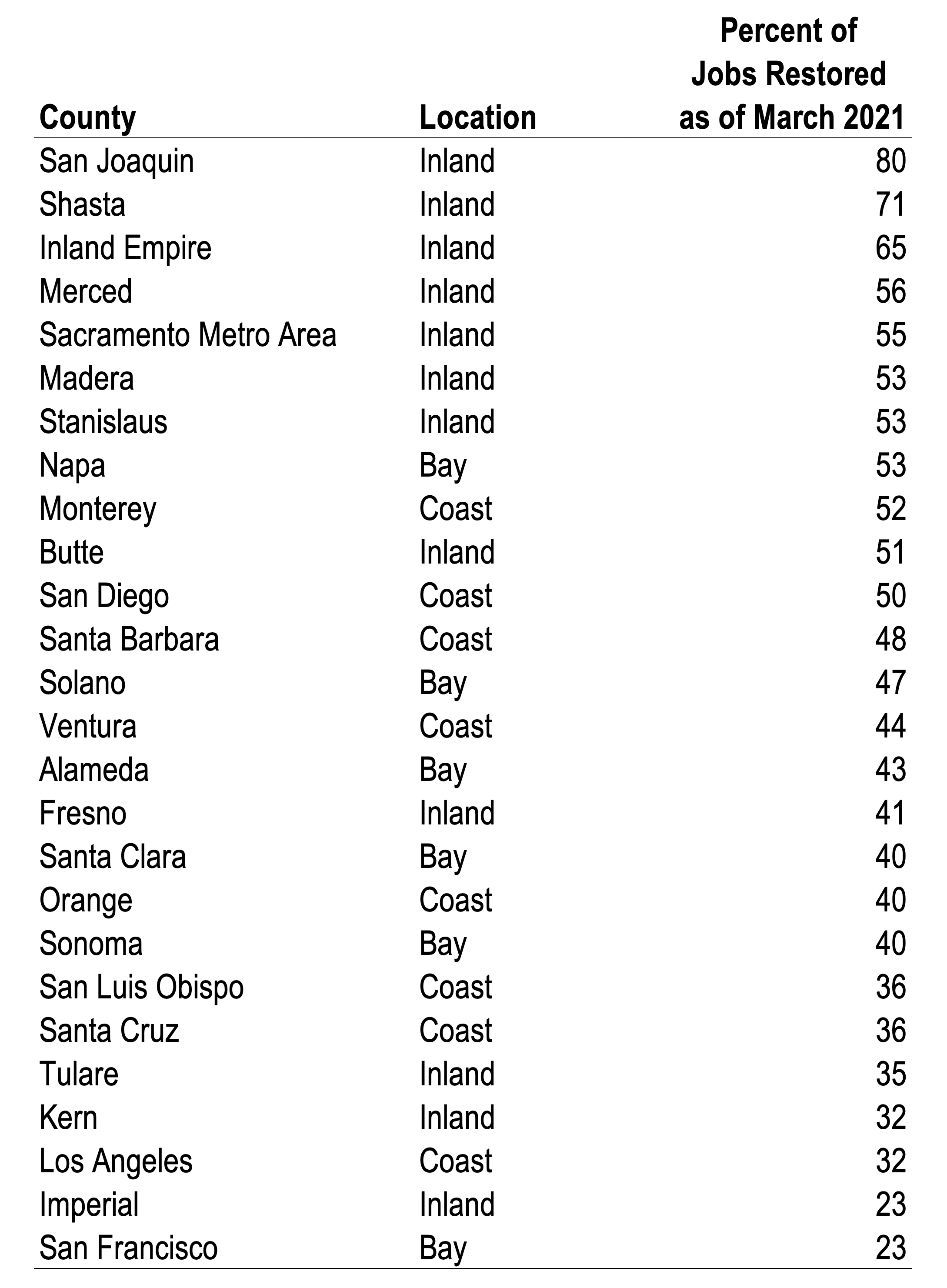
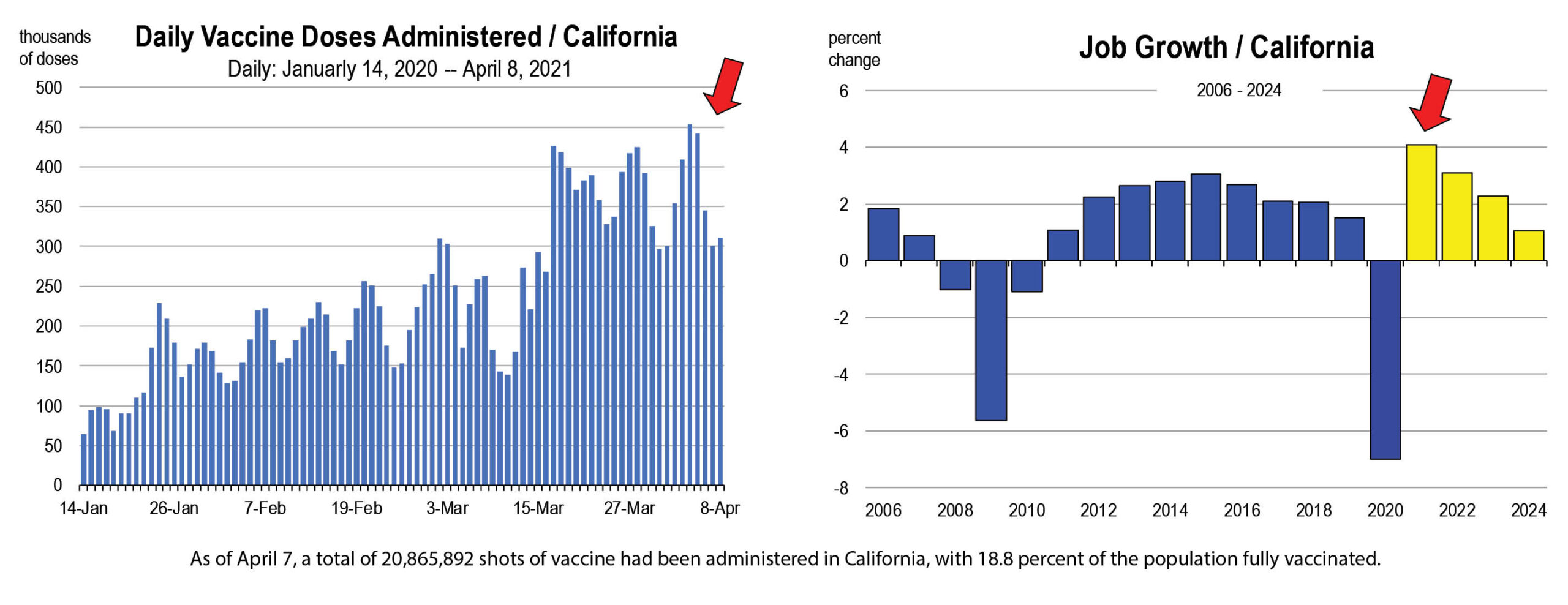
This is an important lesson for California; we’ll also see a surge in the restoration of pre-pandemic job counts as (1) more counties are allowed to open this spring, and (2) as the state entirely reopens by mid-June.

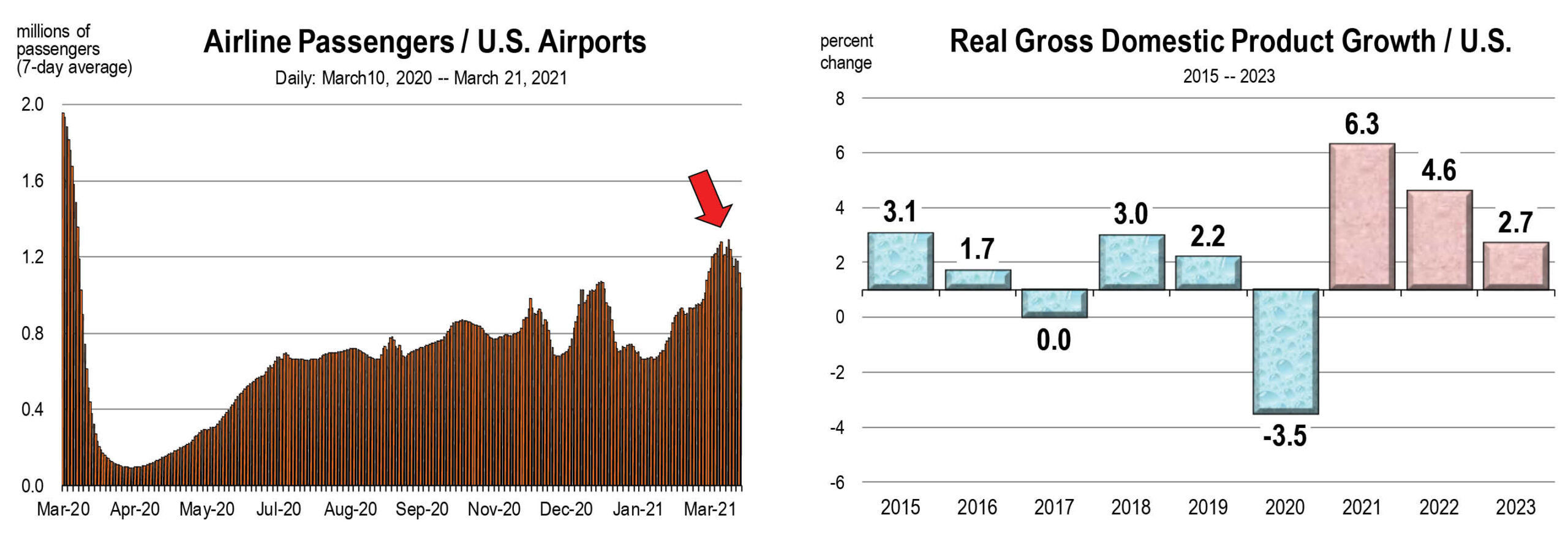
Moody’s produces a “back to normal” index every week. The latest week shows a significant rebound in people’s perceptions of the economy advancing back to “normal,” or what economic conditions were like in February of 2020. The index includes seated diner volume, passengers at airports, people moving around, and time spent at the workplace (rather than at home).

What We NOW Know About the Economy

We have come to understand much more about the U.S. and California economies that we were skeptical about or could not have predicted (1) when the pandemic began in late March 2020 or (2) even as recent as October 2020. This is important because it explains to us and to you why the outlook will be much better than originally predicted this year.

We did not know that . . .

. . . total wage and salary worker income would not be severely impacted by the deep recession, largely because the highest paying jobs and professions were not as impacted.

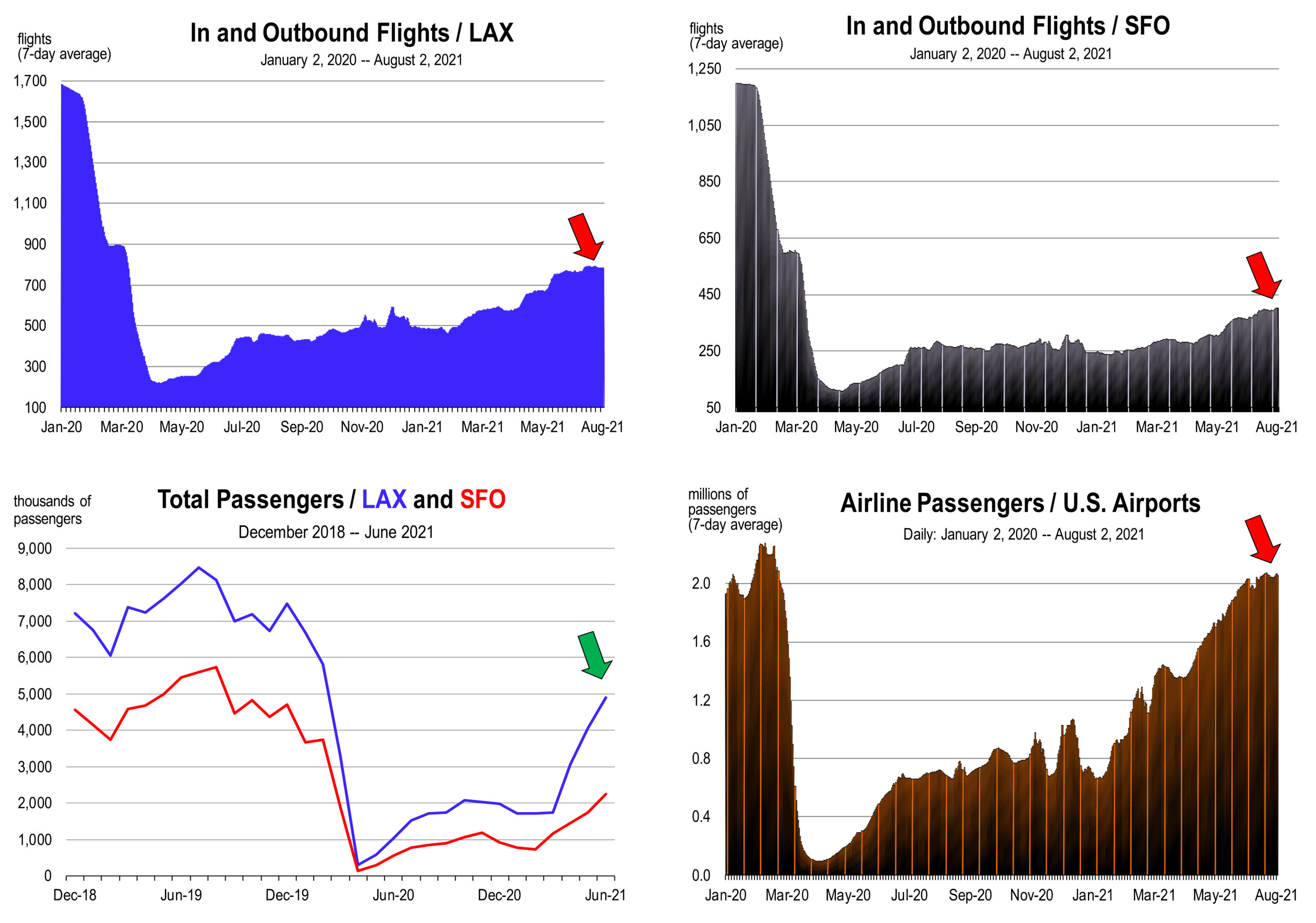
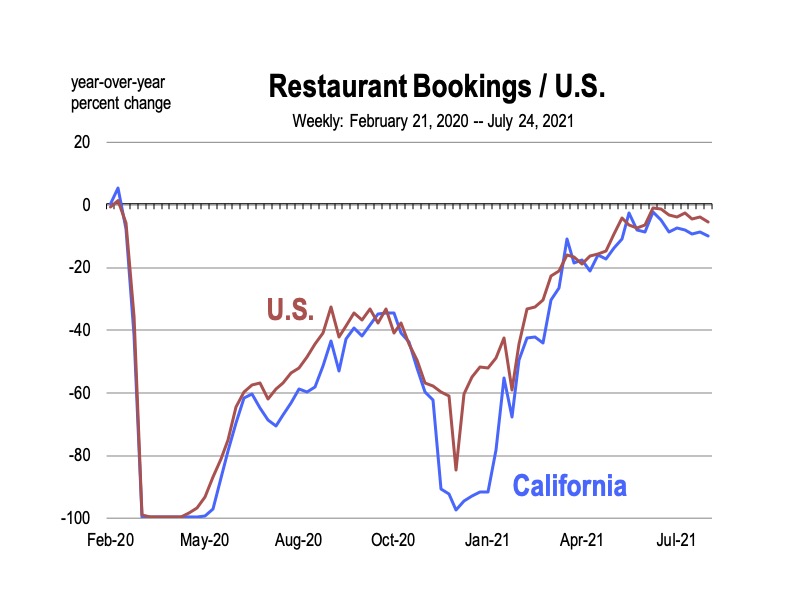
. . . consumers would increasingly become more willing to travel and dine out, though not quite yet at the pre-pandemic pace. We do see a steadily rising number of shoppers, visits to restaurants and salons, gatherings in groups, and travel through airports. It also appears that daily car trips have returned to pre-pandemic levels. Have you noticed being tied up in traffic lately?

. . . despite the original 20, falling to 15, and then lingering to 10 million unemployed workers that have represented the ugly face of the coronavirus recession in the U.S., the economy would bounce back sharply when given the opportunity state by state.

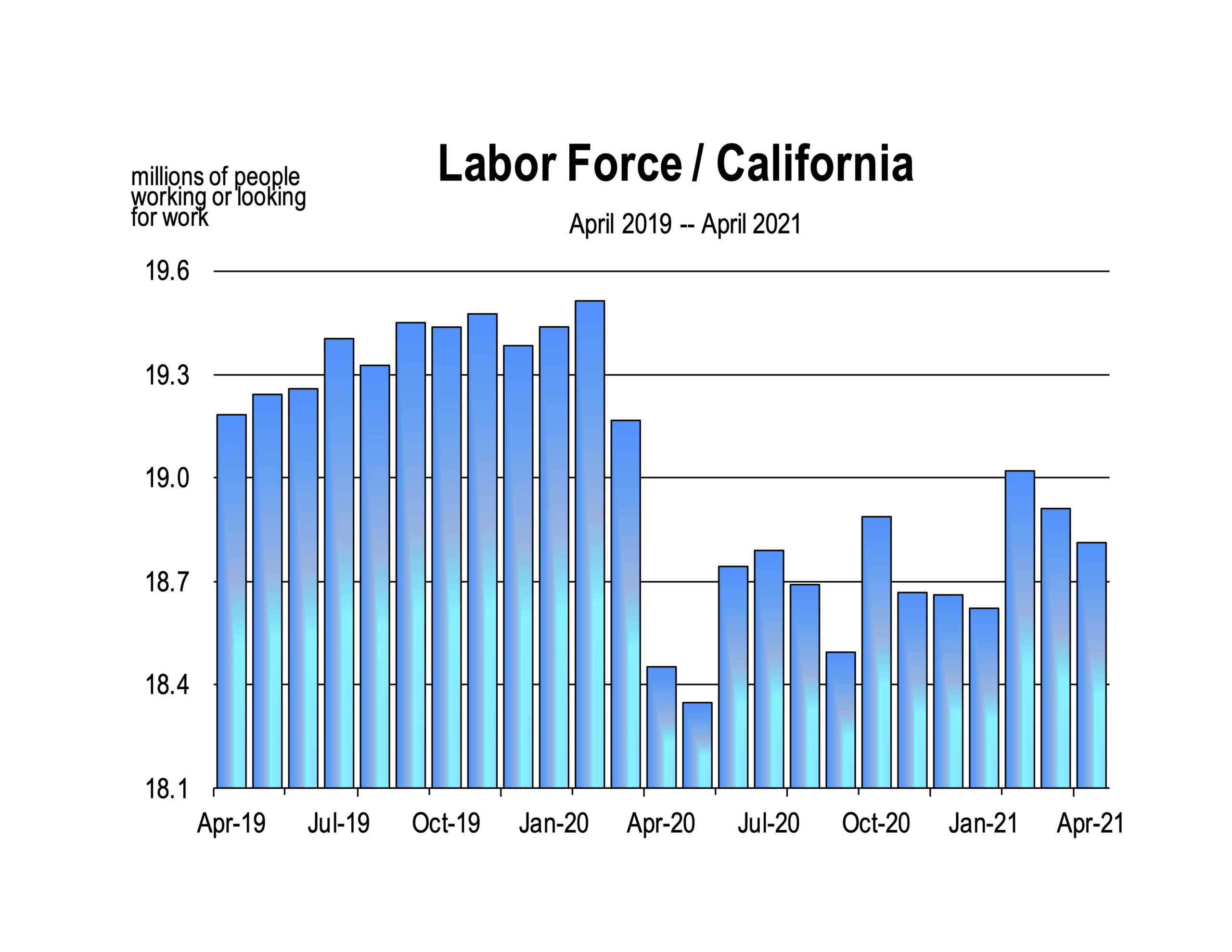
We would never have predicted that the unemployment rate would fall to 6.0 percent a year after the draconian lockdowns all over the country that generated a near 20 percent effective unemployment rate last April. However, we also did not predict that millions of people would drop out of the labor force. If they didn’t, then the current rate of unemployment would be closer to 9 percent today in the U.S. and 11 percent in California.

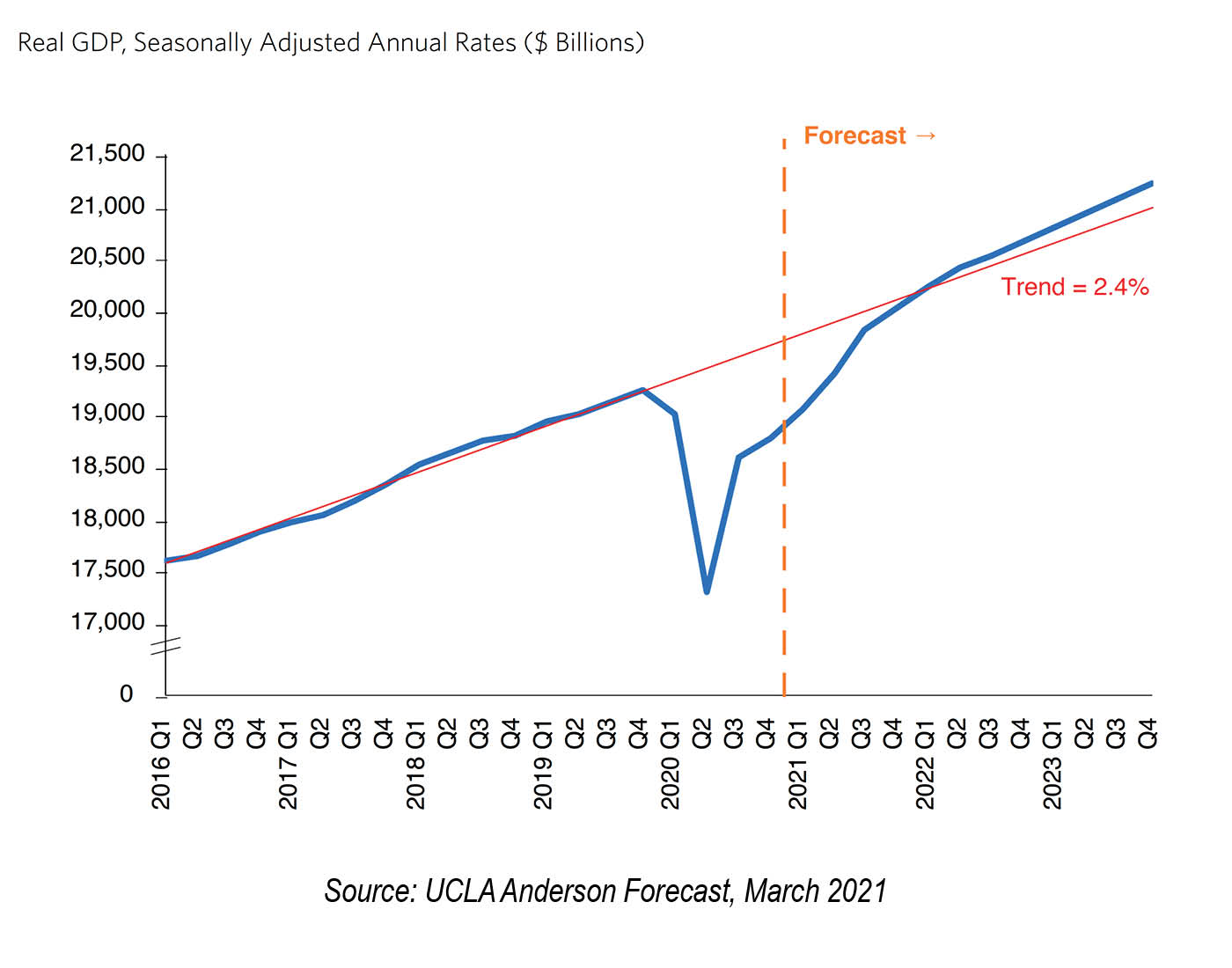
In view of the momentum now recorded in 2021 and the expectations for continued progress through the year, this year’s forecast produces the fastest rate of growth since 1984.

California Reopens

On Tuesday, April 6, most of the 58 counties in the State moved into the Orange Tier, meaning that an expansion of economic freedoms will begin this week and continue through the month (providing another surge is averted).

However, Gavin Newsom announced on Tuesday of this week that by mid-June, the state will do away with the color-coded COVID-19 tier system and fully reopen the economy by lifting most restrictions.

“We are now moving beyond the blueprint,” Newsom said during a Tuesday press conference to announce the plan.” We can confidently say by June 15 that we can start to open up business as usual.  The June 15 goal is contingent on a steady supply of vaccine, along with getting as many people inoculated against the virus as possible.”

Newsom said he expects 30 million people will have received at least one shot by the end of April.

So if this goes forward, then our baseline forecast of a surge in economic activity this year would not be invalidated as I have cautioned over the past 2 months in previous newsletters.

We can expect a sharp reduction in unemployment claims and the ranks of the unemployed going into May and June.

Businesses should start scheduling the return of workers to offices, consider in-person business travel and in-person meetings and conferences, and revisit expectations on product and service inventory to meet the likely expansion of growth this year.

A return to the pre-pandemic normal is still not expected until well into next year, but business conditions over the 2nd half of 2021 will represent a major change from how we have had to cope with restrictions on our activities, the way we have worked, and the limits on social and larger public gatherings. And so it will seem much closer to normal than at anytime since February 2020.

The California Economic Forecast is an economic consulting firm that produces commentary and analysis on the U.S. and California economies. The firm specializes in economic forecasts and economic impact studies, and is available to make timely, compelling, informative and entertaining economic presentations to large or small groups.
Have the Newsletter Sent to Your Inbox

Moving into the Red Tier and Another Surge?

by Mark Schniepp
March 19, 2021

The COVID-19 crisis plunged the U.S. economy into its quickest and deepest economic recession in modern U.S. history. In the near-term, how and when the country gets out of the disaster will primarily be determined by its public health response and the efficacy of rolling out the vaccine.

Economic forecasts can be challenging under normal circumstances, but a global pandemic, the election of a new president, and emergency powers invoked by the states, have resulted in significant additional complications that economists must consider. The extent to which local economies are limited by restrictions on businesses and consumers is a major factor, if not the dominant factor in assessing how the economy evolves this year and next.

Opening Economies

Easing economic restrictions are occurring throughout the nation, and at a snail’s pace in California where most economic activity in the state is still subject to some form of limitation. Restaurant customers are limited as are retail store and personal service customers. Office workers are largely remote, schools are either not open or operating on a hybrid schedule. Sporting events are capacity regulated as are business meetings. Large events are prohibited.

The path of the coronavirus and the effectiveness of the vaccine have the potential to be significant wild cards for the economic outlook this year. But the downside risk is less than the upside risk to the forecast. New, more infectious variants of the virus are racing against the vaccines, the latter of which is winning so far in California. The ultimate victor will influence the implementation of restrictions on various types of business activity.

The extent of the recovery in the public’s perception of economic conditions will remain limited until the labor market improves and the number of reported COVID-19 cases falls significantly, enabling the removal of restrictions and restoring the ability to move freely.

This has largely occurred in many other states but not in California.

An unrestricted economy would likely result in a surge of growth, led by consumer spending, job and income creation, business travel, leisure travel and tourism, and strong demand for public gathering events such as concerts, conferences and sporting events.

Consequently, with the clear abatement of the pandemic, we expect a sharp rebound in the economy, though a return to the normal we knew in 2019 will be delayed until mid 2022 or early 2023.

Source: New York Times, March 19, 2021

The Outlook

As restrictions are eased in California this year, more travel will be unleashed. Visitors should inundate all regions of California. The demand for amusement parks, festivals, fairs, parades, and large events will be prolific as Californians desperately seek a return to normal fun activity.

The outlook calls for improvement, though California will remain limited for much of the calendar year. Unless the office of the Governor changes course, the Blueprint for a Safe Economy will continue to limit the restoration of business in county economies throughout the state. With most counties now advancing to the Red tier on March 16, it will be another 3 weeks before any county can advance to the next best tier, and 6 weeks to move to the least restrictive tier which is still relatively restrictive. Then what?

If mask and distancing mandates are going to be required even after all adult Californians receive the vaccine, business restrictions will also be required, at least in terms of capacities. This takes us through the summer months and into the fourth quarter.

Without a fully open and functioning economy, California faces limits on growth, including hiring. A swell of spending activity by consumers restrained for well over a year cannot fully occur. Therefore the larger spending and jobs surge in California is unlikely until 2022 when we presume all restrictions will have been lifted.

California Tier Assessments

Another Surge?

A potential threat to all the counties moving into the Red Tier and having business restrictions eased is the possibility of another surge, pushing counties back into Purple.

This possibility exists, and infectious disease experts from major universities in California are predicting the onset of another surge—at the end of March or beginning of April. If the European Union is a precursor to the path of the coronavirus in California, then another surge is likely, unless the vaccine can interrupt what has been a reliable predictor of past surges.

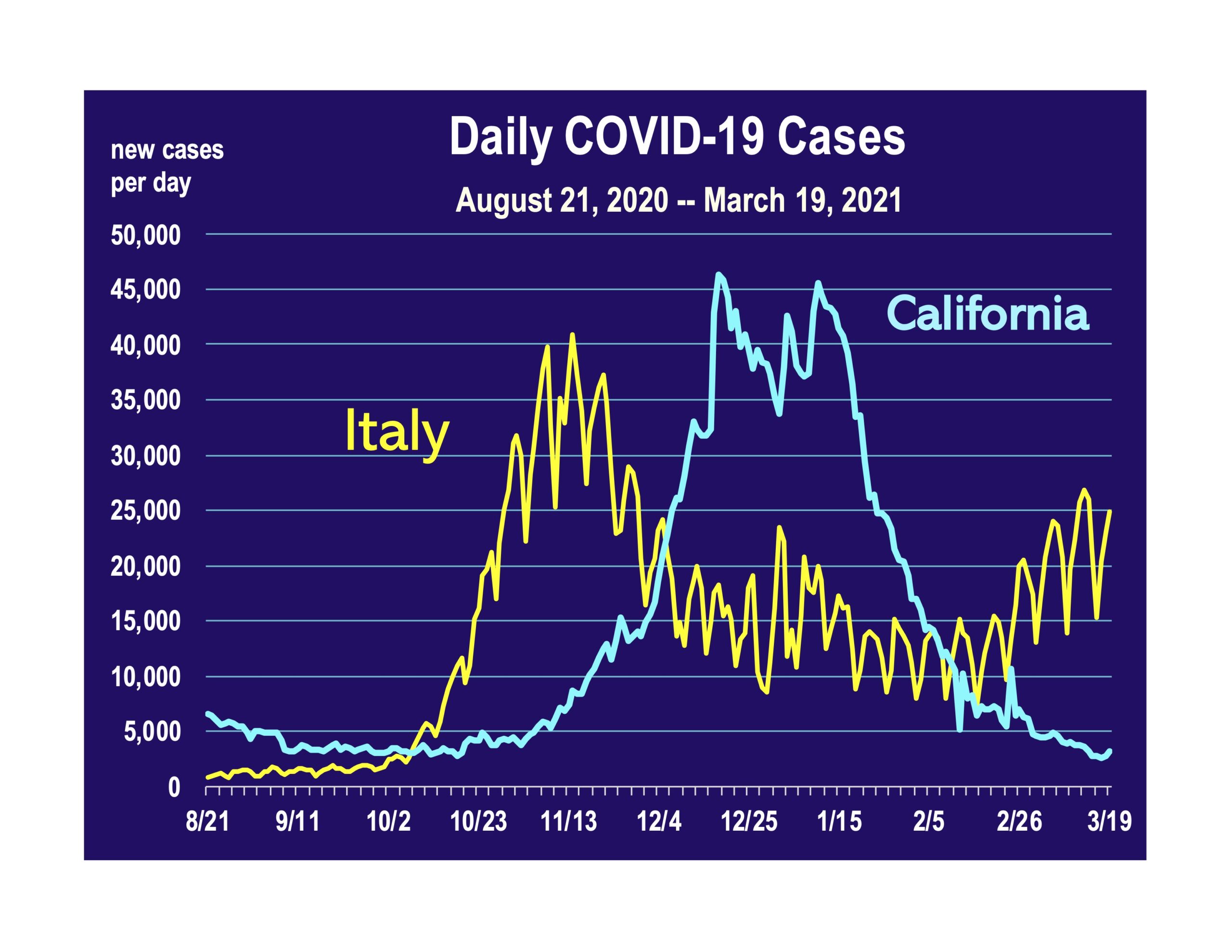
Going back to the beginning, infection rates in European countries rose first, in late February 2020. Italy peaked in late March. Cases in California and much of the rest of the U.S. followed in mid to late March, and peaked in early May.

Cases in Italy began rising last October, leading California by a month. Cases declined in December and January and California followed 3-4 weeks later. Cases in Italy have been rising again, since late February and early March of this year. Their cycle suggests that a rebound in infection rates will revisit California soon.

Germany, France and Italy have imposed new lockdown measures to slow down the third wave of the pandemic, now raging through Europe.

These fits and starts of the pandemic have and will continue to wreak havoc on public health, consumer confidence, the economy, and our ability to provide accurate forward-looking information regarding the economic recovery and when we can return to normal.


The Trevi Fountain in Rome was tourist-empty last week, in light of new lockdown measures imposed on March 15, 2021.

Have the Newsletter Sent to Your Inbox

The California Economic Forecast is an economic consulting firm that produces commentary and analysis on the U.S. and California economies. The firm specializes in economic forecasts and economic impact studies, and is available to make timely, compelling, informative and entertaining economic presentations to large or small groups.
Progress of the Recovery; The Outlook for 2021 is Still Hazy

by Mark Schniepp
February 2021

California

We can’t see it so much in California because of the severe restrictions on business and the fact that we’ve not been able to go anywhere or engage in much spending activity since Thanksgiving. But the growth of the economy has been positive due largely to distribution of goods, technology, and home sales.

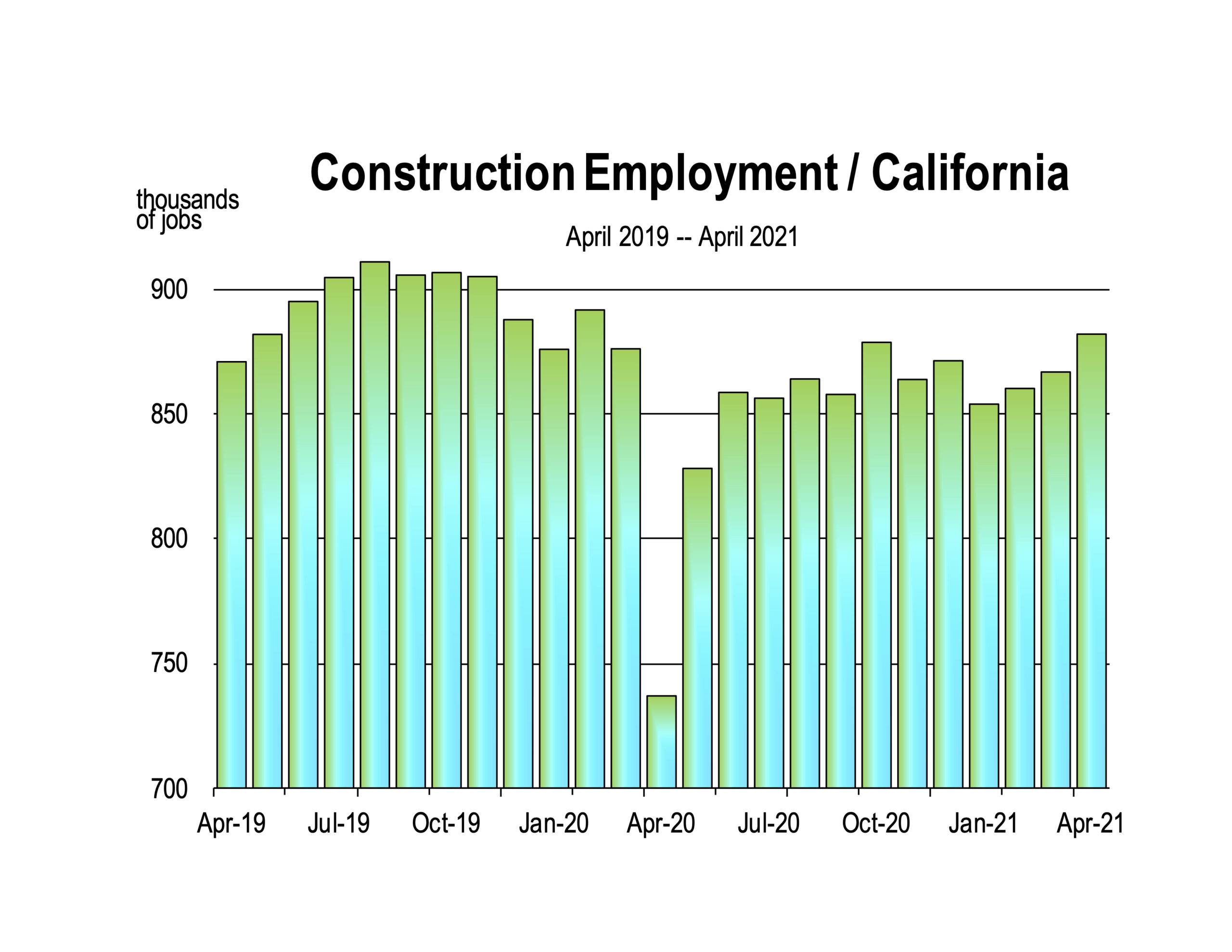
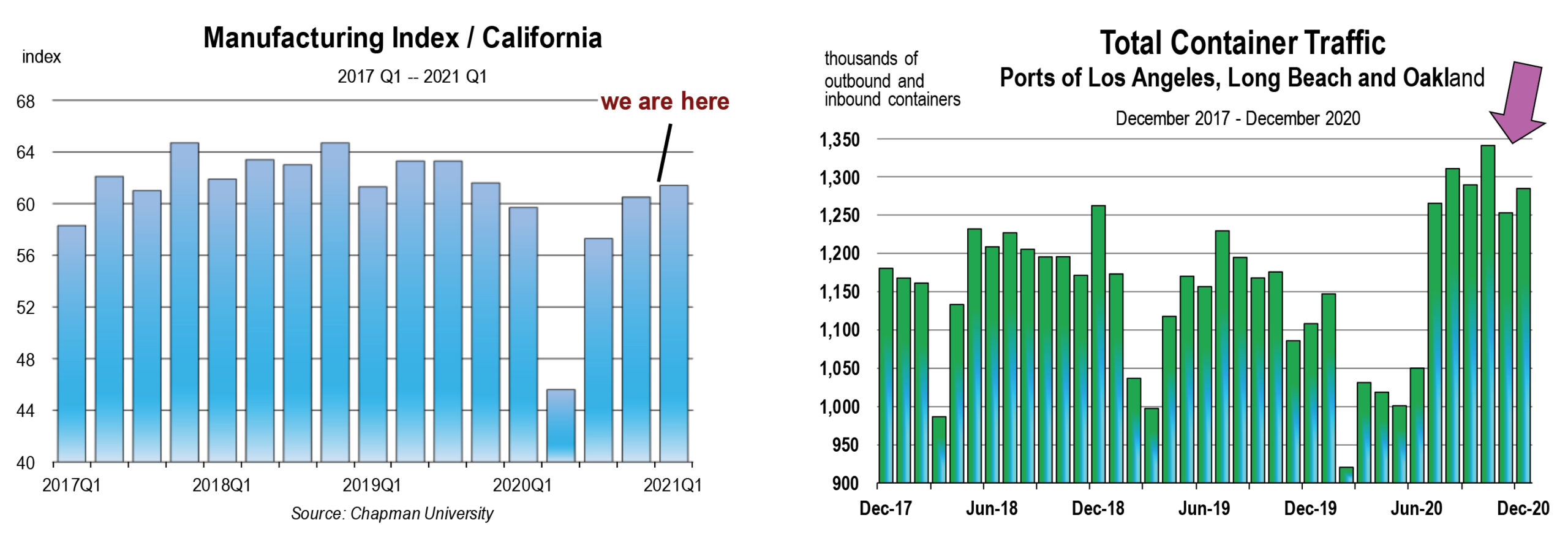
Homebuilding and Infrastructure projects are underway throughout the state, generating a rapid recovery in construction activity. By this month or next, construction employment will have completely recovered from the precipitous decline caused by the pandemic in April, May, and June. The state’s manufacturing sector has now completely recovered.

Imports and exports through the state’s ports of Oakland, Long Beach, and Los Angeles have also recovered sharply in the 2nd half of the year. There was surprisingly more container traffic in 2020 overall compared to pre-pandemic 2019, principally from stuff coming into the U.S. rather than going out.

The 2020 calendar year ended with 9.4 million fewer jobs in the entire U.S. compared to December 2019. California ended up with 1.4 million jobs fewer than in December 2019.

The December jobs report was negative for both the U.S. and California.

The victimized economic sectors that contributed to the downbeat report continue to be concentrated in leisure/hospitality and local government. The severe restrictions on food services, travel, and attractions produced the freefall in leisure, recreation and hospitality revenue and employment. This has contributed principally to City and County governments grappling with major declines in tax revenues.

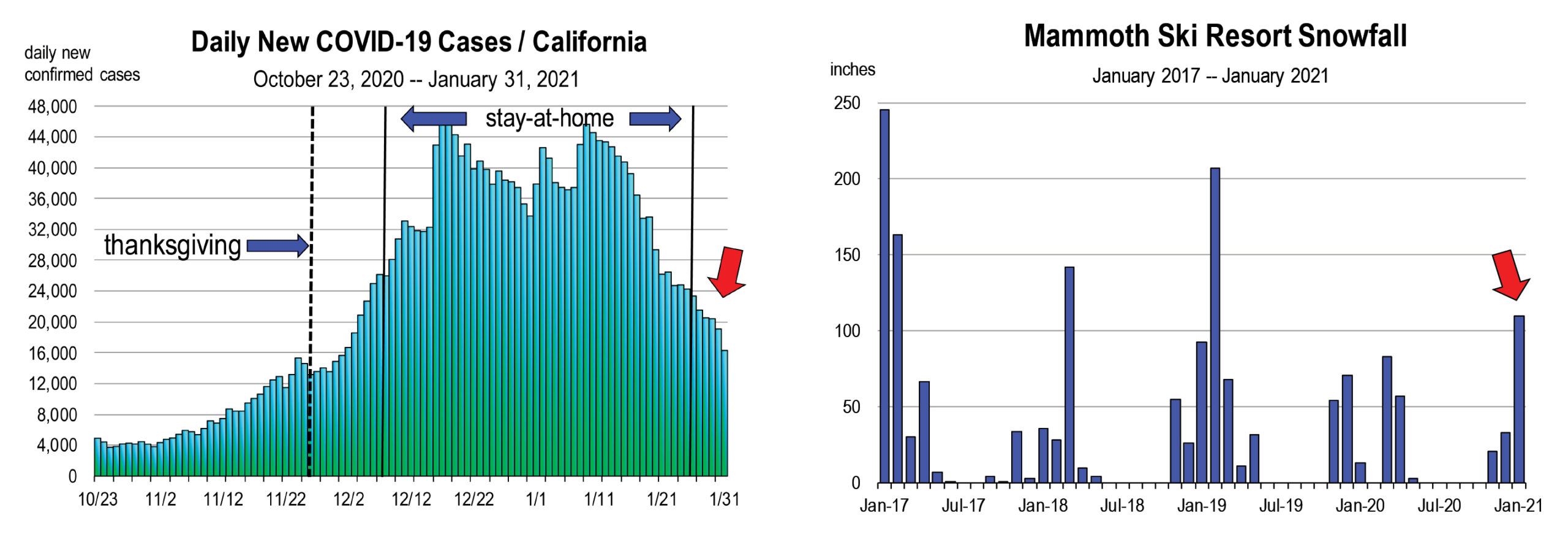
California suffered the most severe business restrictions in the nation during December and January, and generally for most of the 2020 calendar year. We are guessing that restrictions will be gradually eased as clear evidence of fewer cases emerges in California this year. All counties are now in the purple tier of business restrictions after the stay-at-home mandate was ended by the Governor’s office on January 25.

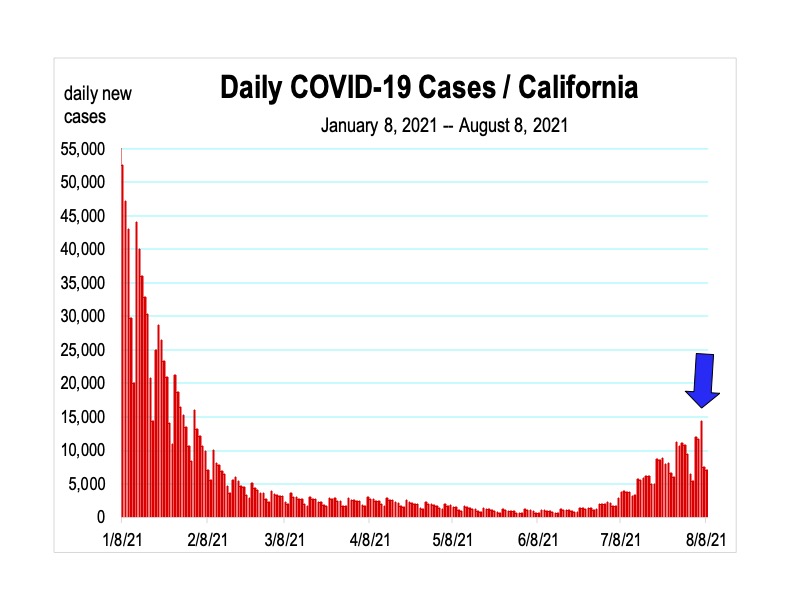
We would also hope that as the number of people receive vaccinations, the number of positive cases will decline. Though the level of daily cases is still high, we are finally seeing a clear abatement over the last two weeks. It’s unlikely however that this reversal of trend is due to vaccine distribution because fewer than 8 percent of the state’s population had received the first shot by the end of January.

In sync with the lifting of the stay-at-home order in California is the deluge of snowfall in the Sierra. Mammoth Mountain received 9 feet of new snow in the week ending January 30. With hotels now able to book reservations, thousands of visitors can inundate the ski resort, and all of the ski areas around Lake Tahoe. Hopefully the ski industry in California can now post a solid 2021 snow season.

The U.S. Economic Recovery is More Convincing

Because the limitations on economic activity in other states have been far less onerous than in California, positive growth measured by employment or sales or fewer unemployment claims per capita has been higher for the aggregate U.S.

GDP growth during the 4th quarter of 2020 weighed in a 4.0 percent, great by pre-pandemic standards but much slower than in the 3rd quarter because of the increased infection rates during the Fall, tighter restrictions to contain the spread of the virus, and the lack of fiscal stimulus which had contributed to the previous two quarters.

Housing is one particular indicator that is contributing largely to GDP improvement.
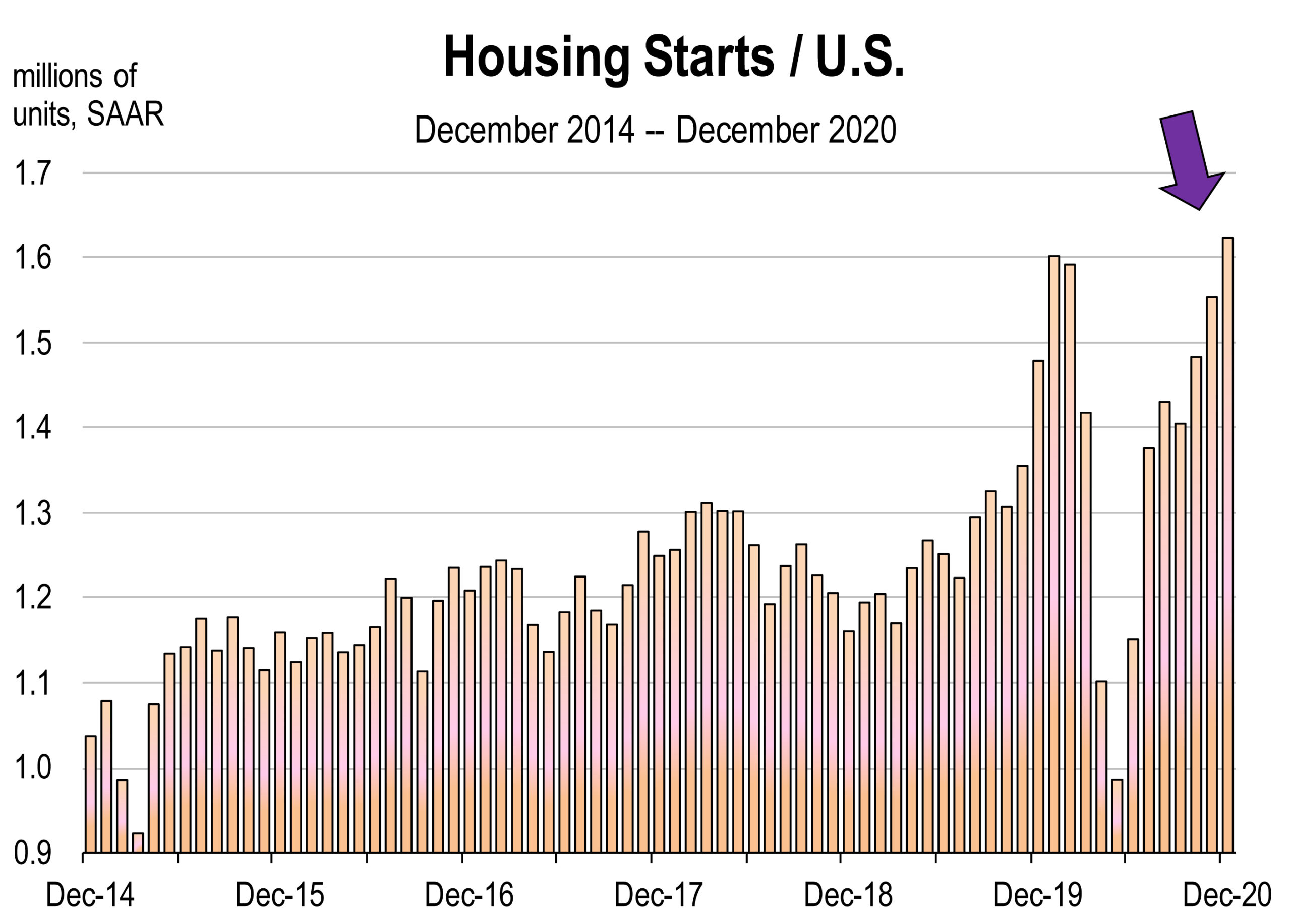
Homebuilder confidence is solid; both housing starts and new home sales have rebounded sharply to their highest levels since 2006.

Home refinance activity remains very strong and existing home sales have surged month after month since June. Total existing home sales during 2020 were also the most since 2006.

30 year fixed interest rates for conventional mortgages were 2.95 percent in late January, consistent with accommodative monetary conditions. At the January meeting of the Fed’s Open Market Committee, the target range for the fed funds rate was kept at 0% to 0.25%. This target is unlikely to change anytime soon.

The manufacturing economy continues to grow. Output has increased in 7 of the last 8 months.

The Moody’s back-to-normal index has been generally slipping the past 2 months, to the lowest level since June 2020. The index evaluates the extent to which the economy is back to pre-pandemic normality. The decline is mostly due to the surging case counts across the nation. Of the 15 states tracked for how the recovery is trending upward, California ranks next to last, just ahead of Illinois.

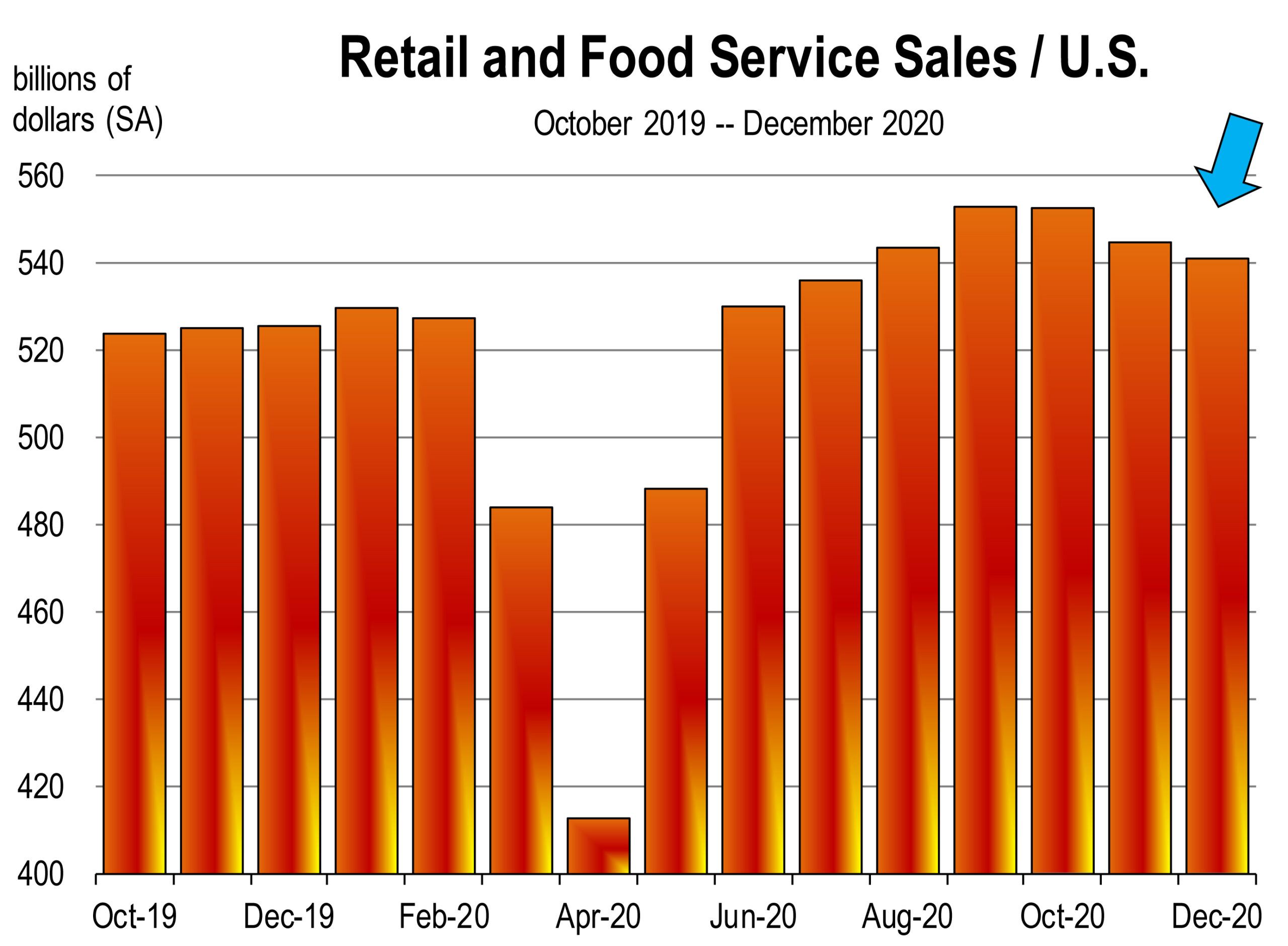
And consumer sentiment is not improving, remaining steadily lackluster. The positive news on the delivery and administration of the vaccines is being offset by increased or sustained restrictions on business activity and the general lack of improvement in the unemployment rate. Not surprising, retail sales have now declined for 3 straight months, under the weight of business restrictions and consumer fears from heightened positive case numbers in the U.S.

Automobile sales nevertheless continue to increase and the pace of sales has now recovered completely.

New claims for unemployment benefits have declined during the last two weeks of January. This is encouraging news although the level of claims is still extremely high. Too many American workers are still out of work. The unemployment rate is 6.7 percent. But add to that the four million people who were working a year ago but have dropped out of the labor force and are therefore not included as unemployed. Counting them would boost the nation’s unemployment rate to 9.0 percent.
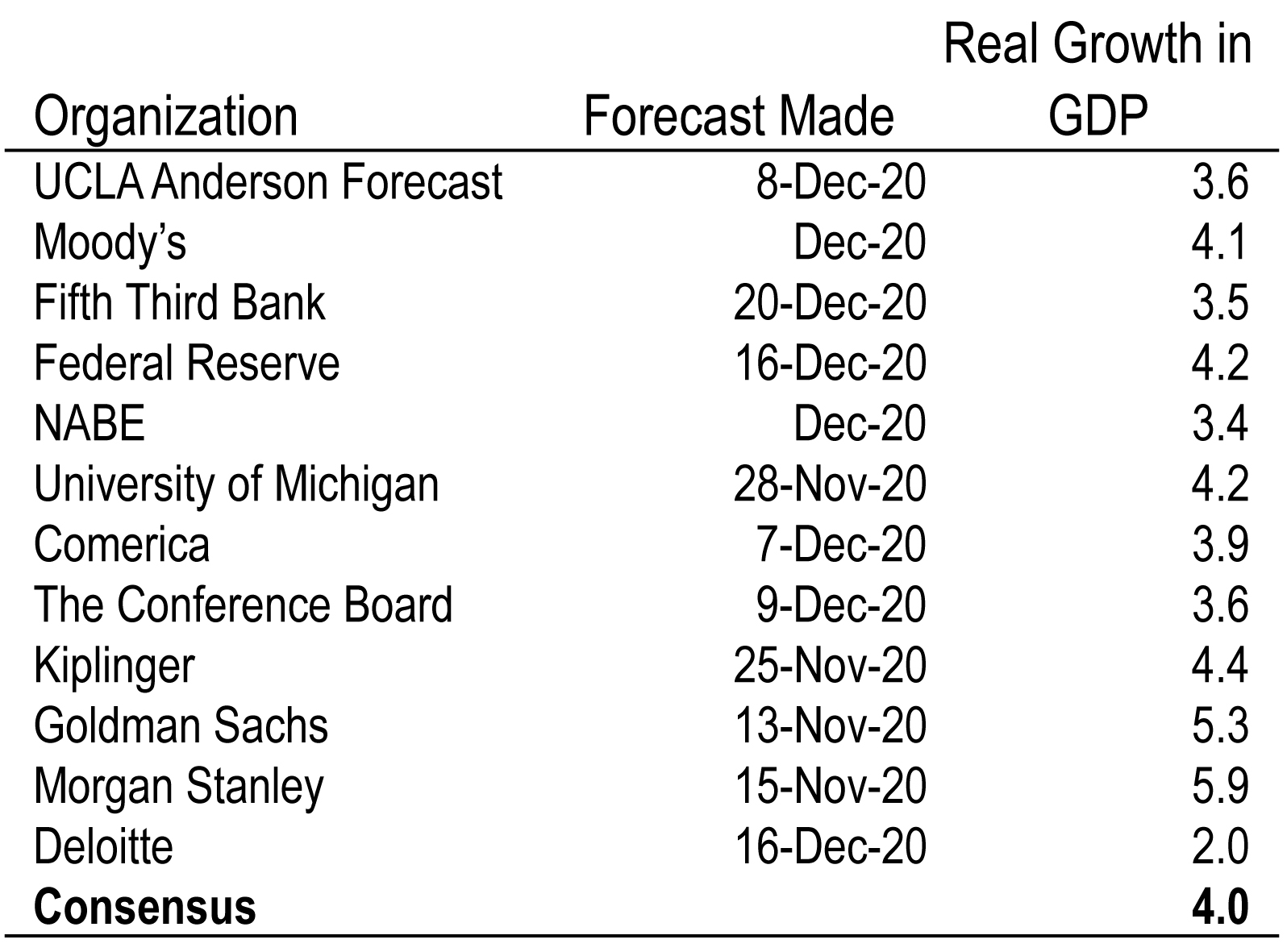
The US economy is clearly in recovery, but the start in 2021 is slow. The pace of growth is expected to accelerate in the second half because widespread vaccinations in the first 5 to 6 months of the year will enable the economy to recover more rapidly thereafter.

How strong the economy is later this year will depend on how the virus evolves and the effectiveness of the vaccines and mitigation efforts.

However, please read our January newsletter for my major concern about the outlook for general economic growth over the full calendar 2021 year. There are still too many big unknowns. Rapid recovery during the 2nd half of 2021 relies on an open economy. We can’t be sure the economy will be wide open in June.

Vaccine Update

There are two vaccines being administered in this country and many more worldwide at this time. Two additional vaccines—by Johnson and Johnson, and Novavax—are now completing clinical trials, with results and FDA approval expected this month.

The vaccine delivery of doses to individuals is the subject of criticism and frustration. Millions of doses are sitting unused in freezers. The original ambitious schedule of getting 20 million people inoculated by the end of 2020 was finally accomplished 22 days late on January 22nd. California has consistently ranked at the bottom of states in the percentage of distributed vaccines that have been administered. And because of its high daily positive caseload, California needs to vaccinate as quickly as possible.

Delays have been caused by the holidays, the tidal wave of new coronavirus hospitalizations which have interrupted vaccination campaigns, insufficient staff needed to administer shots, the challenges of the ultra cold storage requirement of the Pfizer vaccine, the wrong vaccine being used, fewer vaccines being delivered, and other delays.

The recovery period we are in might be called the vaccine phase. During this phase consumers remain reticent to engage in activities usually requiring high human contact and remain largely at home and/or isolated. This keeps a lid on spending and economic growth. Also during this time, business restrictions remain firmly in place in most states, constraining business openings, hiring, and opportunities for consumers to spend.

We are now looking forward to the post vaccine period of recovery when pent up demand for services is expected to surge. Therefore, we will be watching closely how restrictions are lifted and how consumer demand evolves as herd immunity from coronavirus is generated by a dominant share of the population receiving the vaccine. That is not expected however until the late Spring.

The Outlook for 2021

Presenting a credible outlook for the U.S. and California today requires knowledge of how the coronavirus will evolve in 2021. We’d like to think the pandemic will be called off by summer. That’s what we thought nearly a year ago, in March of 2020.

Right now, travel bans are still in effect. Rigorous testing for airline passengers entering the U.S. is now required. Effective January 26, the CDC now requires all air passengers including U.S. citizens to present a negative COVID-19 test, taken within three calendar days of departure.

Travel to most of Europe is still limited to essential workers only. The U.S. is still not on the welcome list. Travel from Europe to the U.S. is mostly prohibited. Ditto China, Brazil, and South Africa.

It is largely unknown when these conditions will change. Consequently visitor industry contribution to the U.S. and California economy is uncertain.

U.S. resident spending is expected to grow this year, for housing, food, clothing, autos, gasoline, furnishings, and healthcare. The unknowns include education, entertainment, recreation, and personal care.

When business restrictions are largely lifted, most consumers will return to pre-pandemic behaviors, though some reticence toward high human contact activity will still characterize some consumers. Consequently, we don’t anticipate airline, cruise ship, or tour bus travel to recover quickly.

The reticence will extend to live public gathering events, such as concerts, county fairs, or sporting events. These activities may remain social distanced anyway for most of the year, limiting audiences.

The outlook for the 2021 economy remains hazy. Most of us were glad when calendar 2020 ended. But so far, 2021 is looking a lot like 2020.

Have the Newsletter Sent to Your Inbox

The California Economic Forecast is an economic consulting firm that produces commentary and analysis on the U.S. and California economies. The firm specializes in economic forecasts and economic impact studies, and is available to make timely, compelling, informative and entertaining economic presentations to large or small groups.


Outlook for 2021: Can We Count on the Rosy Consensus Forecast?

by Mark Schniepp
January 4, 2021

2020 is now in the rear view mirror. For the economy and for most every living person, the year was horrific. If anyone was guessing, they’d likely say that the outlook for 2021 would be better if not infinitely better, especially now that the world is being vaccinated meaning the pandemic will soon be eradicated.
Nevertheless I’m still concerned. And I hope I’m wrong about what I’m writing about in this month’s newsletter.

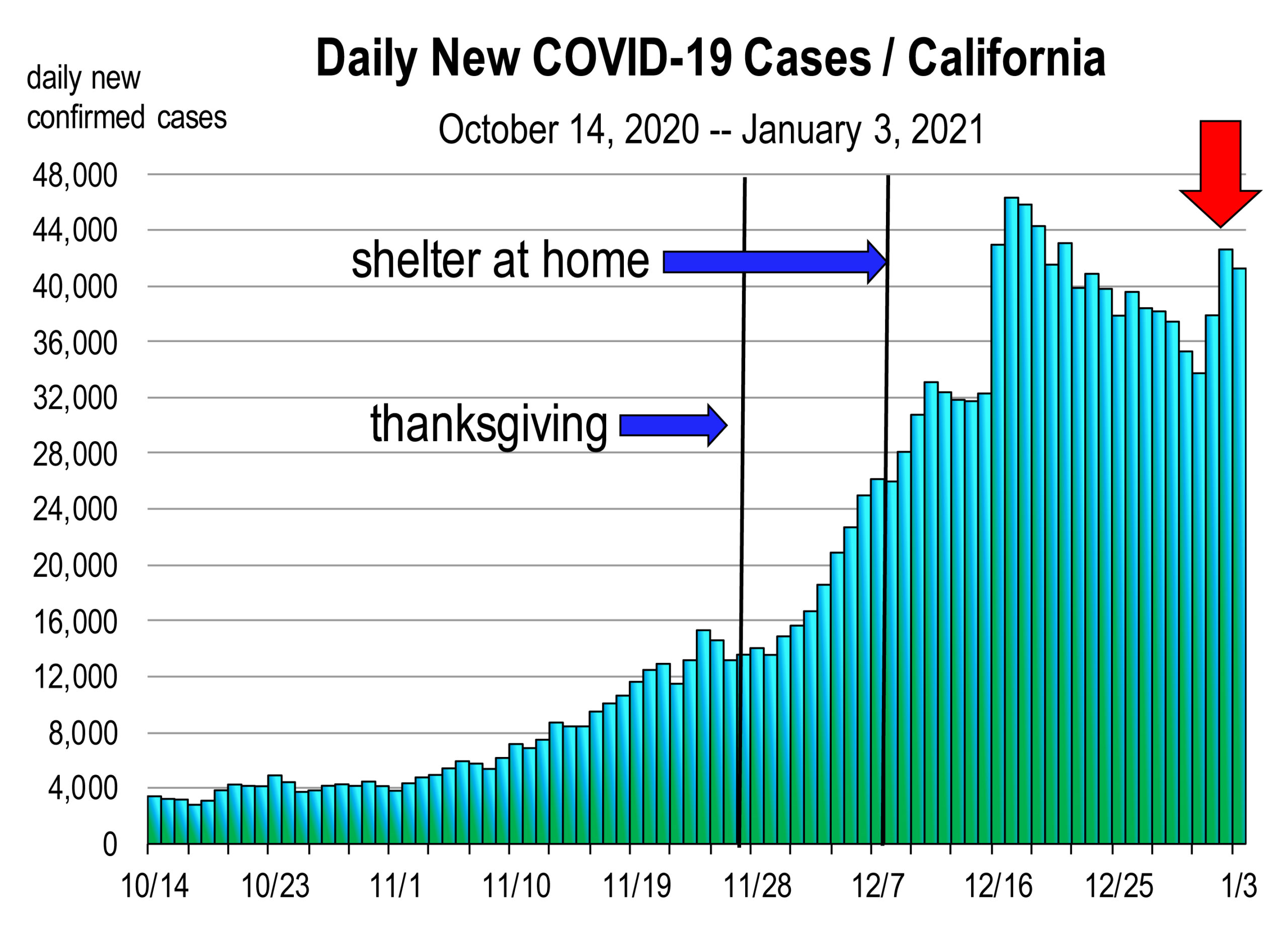
U.S. economic forecasts for real GDP in 20201 are shown here from a number of organizations.

Real GDP contracted 3.7 percent in 2020, and grew 2.2 percent in 2019. So a 4.0 percent consensus forecast for 2021 appears quite auspicious, and encouraging.

With a fair amount of growth, the Fed expects the unemployment rate to drop to 5.0 percent in 2021. That implies another million jobs created during the year and greater mobility of consumers as they buy goods, services, entertainment and recreation.

The outlook for 2021 should be easier to predict than what we just went through. But then, practically anything would be easier compared to 2020 when guessing when and how much businesses could operate was a game of musical chairs.


Today the in-person California economy is largely closed. There is still production and in-person sales of retail goods including food, clothing, home supplies and a few services. There is more online acquisition of products than ever before.

Many services are being provided in spite of the prohibitions, such as personal care services like manicures and haircuts. Gym recreation activities are relatively widespread, both legally outside and illegally inside.

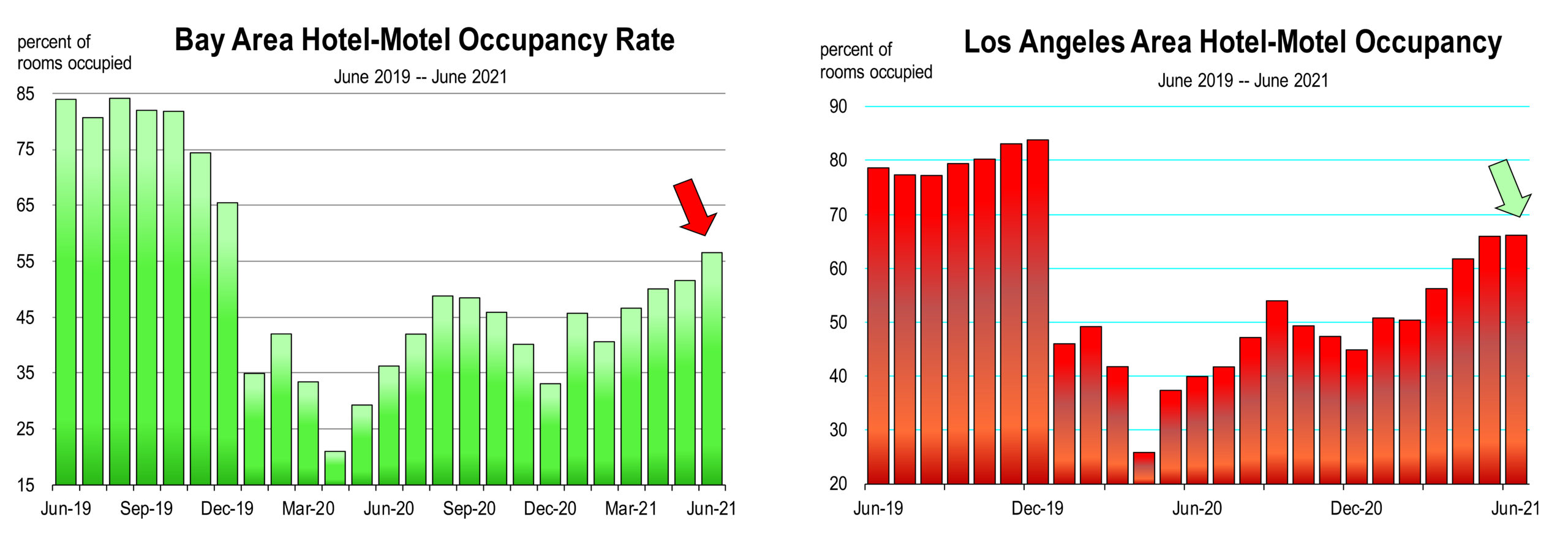
Hotels are closed unless you are traveling in an official essential worker capacity. Short term rentals are also supposed to be prohibited.

Construction activity is busy in the state. Agricultural production continues though the industry’s workforce has sharply contracted because the restaurant industry is largely closed.

The case counts are not diminishing, despite the severe restraints on business, the mask mandate, the curfew, and the prohibition of gatherings. And unless case counts begin to meaningfully decline soon, an even larger pullback in business activity than expected might ensue.

A self-sustaining recovery will not occur until the vaccines are widely available, likely by the spring of 2021. Only then will many consumer-facing businesses begin to function more normally. Only then will businesses ranging from restaurants and hotels to public transit to entertainment venues begin to function more normally. Or will they?

Two vaccines are well underway, Pfizer and Moderna. Two additional vaccines are coming in January or February. Their delivery and implementation around the country is breeding new optimism. There is a strong belief that a return to normalcy is possible by mid year 2021. The stock market’s performance would suggest this as do the recent economic forecasts for the nation in 2021.

We all believe that the distribution of vaccines that started three weeks ago will begin to ease the medical necessity for restrictions.

But with the vaccine now being administered to thousands of recipients in California, there are still risks that the usefulness of the results of the vaccine will be delayed, causing economic growth to fall short of expectations.

This is because there is an emerging narrative that after receiving both vaccine doses, we will still need to wear masks and social distance. What?

“We don’t know if all the vaccines will be equally effective. We don’t know whether a vaccine prevents asymptomatic infections and if there’s still the possibility that a vaccinated person could transmit the virus without knowing it. Because there’s still a chance that you could be a silent carrier even after getting vaccinated, wearing a mask, practicing social distancing, and handwashing all remain important.”1

If this is true and mask and distancing policies are still widely enforced, it’s probable that restrictions on businesses will also remain largely in place even after much of the population is vaccinated.

I’m just guessing but in view of the very cautious approach we have observed in California since July regarding limited business openings, a continuation of a regime of restrictions for much of calendar 2021 would not be surprising.

Consequently, despite widespread participation of the population with the vaccines, if there are persistent restrictions on businesses during 2021, a robust recovery will not be possible. Or certainly not the kind of growth that is being forecast for the U.S. economy. We will see fits and starts, and generally positive growth, but no significant surge in overall economic activity.

I hope I am wrong, but be prepared for delays in reinstating the California economy to February 2020 conditions. Also be prepared for many schools, colleges and universities to remain closed for the remainder of the current 2020-2021 academic year. The loss of that activity alone produces a meaningful drag on the state’s economy.

The absence of large events, such as concerts, conventions, theatrical performances, and audience attended sporting events also dampen many options for consumer spending, and needless to say, job creation or restoration of thousands of these jobs which have been absent for 10 months now and counting.

Scenario A: Restrictions are removed with widespread dissemination of the vaccine

The outlook assuming conditions return largely to normal by mid year has California GDP rising 3.8 percent this year with strong gains in the 2nd half. Employment surges in construction, professional services, and healthcare. State and local government jobs will also start to recover in fiscal 2022 which starts in July.

People will begin to travel both domestically and abroad this summer as the world opens up. I would expect Disneyland to have opened, the Dodgers to be playing to live audiences, business meetings and large conventions to resume, and entertainment venues to ramp up again.

Largely, conditions are back to normal and the second half of 2021 would look quite vibrant.

Scenario B: Restrictions persist well into 2021 even after the majority of Americans are vaccinated

Here is what is closed now:

  • Movie theaters
  • Live audience sports
  • Amusement parks
  • Bars, breweries and distilleries
  • Wineries
  • Any indoor recreational facility
  • Hair salons and barbershops
  • Personal care services
  • Museums, zoos, and aquariums
  • Family entertainment centers
  • Card rooms and satellite wagering
  • Any indoor public gathering

For most of the state, restaurants are entirely closed for indoor or outdoor dining. And this has led to the further collapse of food service jobs during the month of December.

The December 2020 Stay-at-Home order was extended by 3 weeks into January by Governor Newsome on December 29, 2020. Consequently, most of the state’s hospitality economy is in for another empty month of growth.

Clearly, Stay-at-Home orders will be rescinded as positive case counts decline and ICU capacity loosens up. But the nightmare scenario going forward would extend many restrictions on the above list though the spring and into the summer months of 2021. That said, vacation travel will be as unlikely then as it is now. Schools will not open broadly until the fall of 2021.

In the meantime, rising unemployment and layoffs from accelerated restrictions will suppress demand for a variety of goods and services. This is why a second stimulus bill is desperately needed to circumvent the growing likelihood of declining growth this quarter.

The U.S. will not return to its pre-COVID-19 employment level until the end of 2023, and many industries face more long-lasting impacts. Risks to the outlook in 2021 are mostly negative. The increased spread of the virus across much of the country could result in an even larger pullback in business activity than expected.

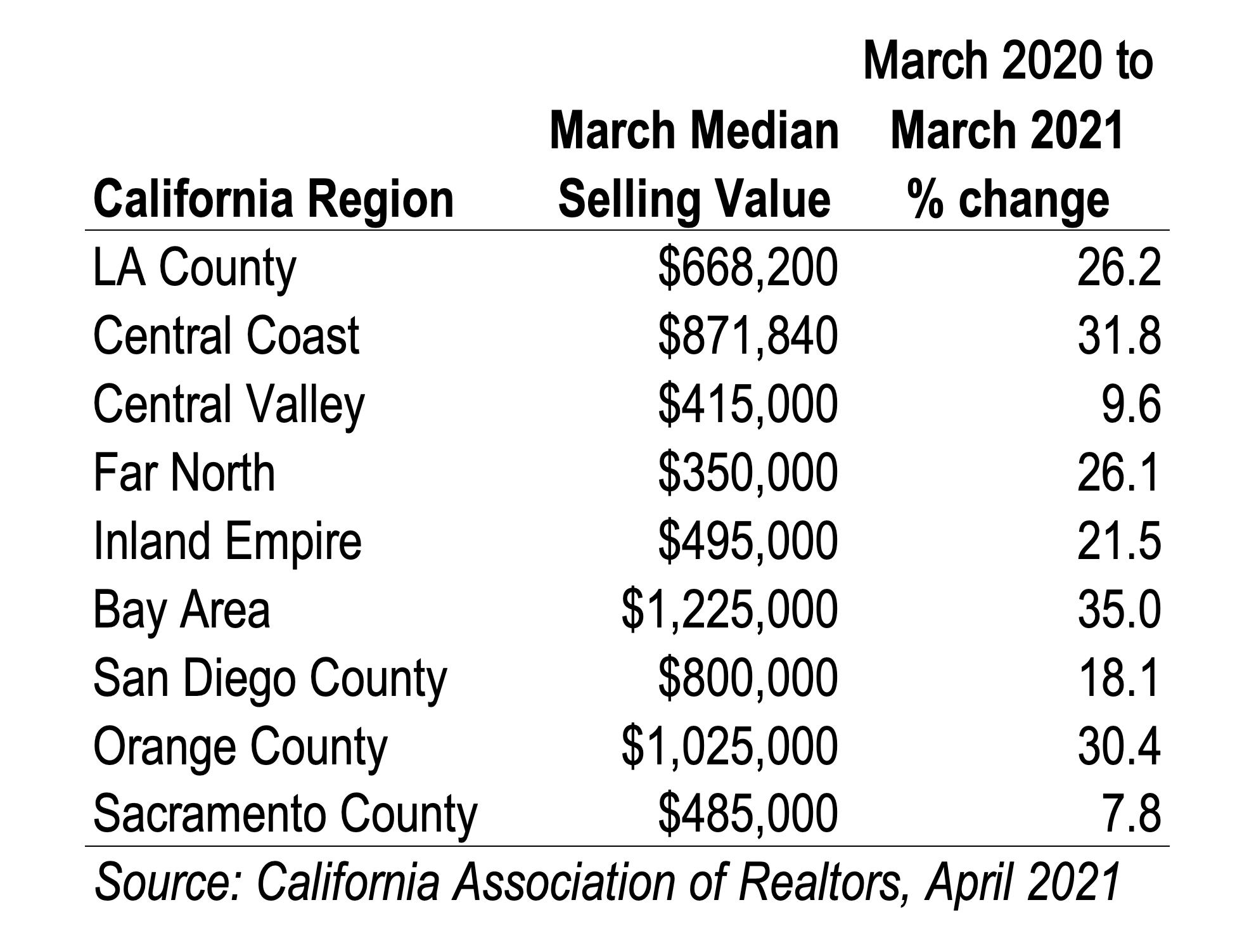
Under either scenario, the housing market is forecast to generate an increase in sales and selling values. The California Association of Realtors’ forecast for 2021 has home sales rising 3.3 percent and the median price edging up between 1 and 2 percent (in the wake of an 8.1 percent increase in home values during calendar 2020).


1 https://www.inquirer.com/philly-tips/covid-vaccine-coronavirus-mask-vaccinated-efficacy-20201216.html

Have the Newsletter Sent to Your Inbox

The California Economic Forecast is an economic consulting firm that produces commentary and analysis on the U.S. and California economies. The firm specializes in economic forecasts and economic impact studies, and is available to make timely, compelling, informative and entertaining economic presentations to large or small groups.