Mark Schniepp
May 2026
There is this notion that AI is now showing up everywhere except in the recent macroeconomic data that measure worker productivity.
At the economy-wide level, the proof is still emerging and less clean. At first, the AI-related investment and capital utilization that has occurred, largely in 2025, rather than direct worker productivity has driven recent strength in productivity.
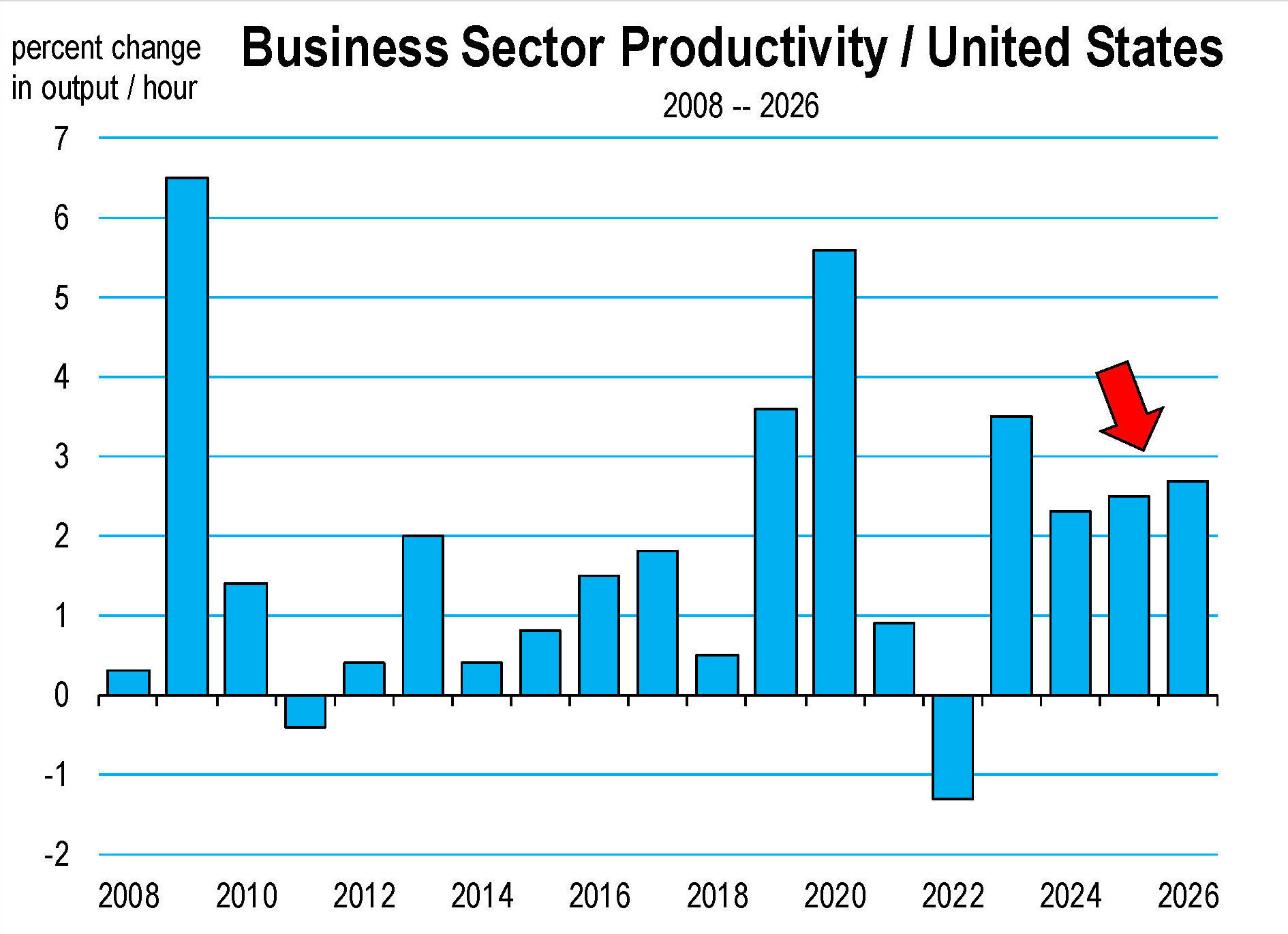
However more evidence to date suggests AI has begun to yield measurable productivity gains, with data indicating an increase in individual task efficiency. However, the effect on aggregate macroeconomic data is still emerging.
Broader economic data, such as U.S. labor productivity growth, is climbing to annualized rates ranging between 1.8 and 2.7 percent outperforming the sluggish 1.4 percent average of the previous decade. Economists attribute much of this to early AI capital investment and business reorganization.
Across one hundred thousand real world conversations, Anthropic, makers of Claude, estimates that AI reduces task completion time by 80 percent. Extrapolating the savings in time valued at Bureau of Statistics wage rates across legal, management, and healthcare users, an annual labor productivity increase of 1.8 percent is inferred by Anthropic.[1]
Other studies show users completing tasks between 76 and 176 percent faster, with specific fields like software development observing measurable bumps in output.
Particular Sectors Impacted
Gains are highly concentrated. High-skilled services (like finance) are seeing the most immediate and substantial gains, while broad, economy-wide adoption is still maturing.[2]
Workplace experiments have shown large productivity gains:
1. Customer support workers complete more tasks with better quality using AI
Customer service agents using AI resolve 14 percent more issues per hour.[3] Additionally, a Stanford-MIT study of more than 5,000 customer support agents found that generative AI increased productivity by 14 percent overall, while less experienced workers improved performance by roughly 35percent.[4] Less experienced workers benefit from AI by accepting its recommendations and learn skillsets that usually come with experience. Researchers concluded that AI systems often function as “skill equalizers,” disproportionately benefiting novice workers.
2. Professional writers using ChatGPT finished work faster with improved quality,
Microsoft Copilot users reported saving an average of 11 minutes per workday in early workplace studies.[5]
3. Software developers using coding assistants increased the number of tasks they completed per day.[6]
GitHub Copilot users complete coding tasks 55 percent faster.[7] Additionally, a 2025 field study involving 4,867 developers across three firms found AI coding assistants increased completed tasks by approximately 26 percent.[8]
U.S. labor productivity growth accelerated to roughly 2.7 percent in 2024 after averaging about 1.4 percent during the previous decade, though economists still debate how much of the increase is directly attributable to AI. Economists describe the current period as a possible “AI J-curve,” where heavy investment in data centers, software, and organizational restructuring occurs before full productivity gains appear in national statistics. The most rigorous productivity research consistently finds a skill-leveling effect: AI helps weaker performers far more than experts. In a landmark study of 5,179 customer service agents, novice workers improved by 34 percent while top performers showed minimal gains—and even slight quality declines. This pattern repeats across every major peer-reviewed study.[9]
Based on a recent (February 4 to February 19, 2026) poll, Gallup surveyed 23,700 workers and found that many U.S. employees who use AI say it boosts their productivity, especially when employers support the tools and fit them into workflows.[10]
In general, surveys indicate that adoption remains uneven across firms. The 2026 Gallup poll found that although half of employees report some AI usage, only about one-quarter use AI frequently in their daily workflow. Managerial support and integration into existing business systems strongly influence whether productivity gains materialize.[11]
The empirical literature to date supports several conclusions with relatively high confidence. Workplace studies demonstrate large productivity gains from the adoption of AI for writing, customer support, software development, and translation, across occupations.
Experiments consistently found productivity gains of between 15 and 50 percent.
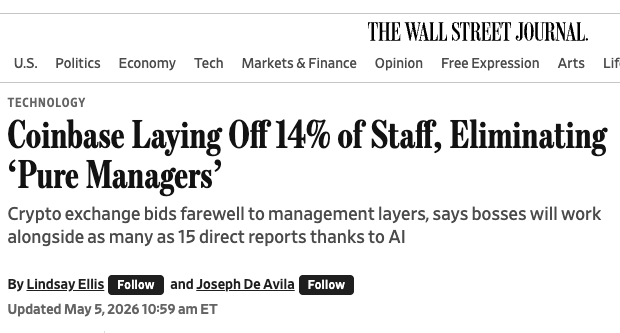
Wall Street Journal, May 5, 2026, https://www.wsj.com/tech/coinbase-to-slash-14-of-workforce-as-part-of-restructuring-62b9d27d
Worker Displacement
Studies in 2024 and 2025 found little evidence of economywide job loss or wage decline despite the rapid adoption of AI systems in the workplace. Alternatively, there is now more compelling evidence of job loss, especially in California, which is supported by myriad reporting’s and announcements on job displacement particularly in technology sectors.[12]
Challenger, Gray & Christmas estimated that approximately 20 percent of tracked global layoffs in early 2026 were directly attributed to AI adoption and automation. California WARN filings showed engineers, data scientists, and customer-support workers were disproportionately affected.[13]
California technology firms announced more than 26,000 job cuts during the first two months of 2026 alone, with firms including Amazon, Meta, Workday, Block, Pinterest, Google, and C3.ai citing AI-related restructuring and automation efficiencies. The cuts — concentrated in 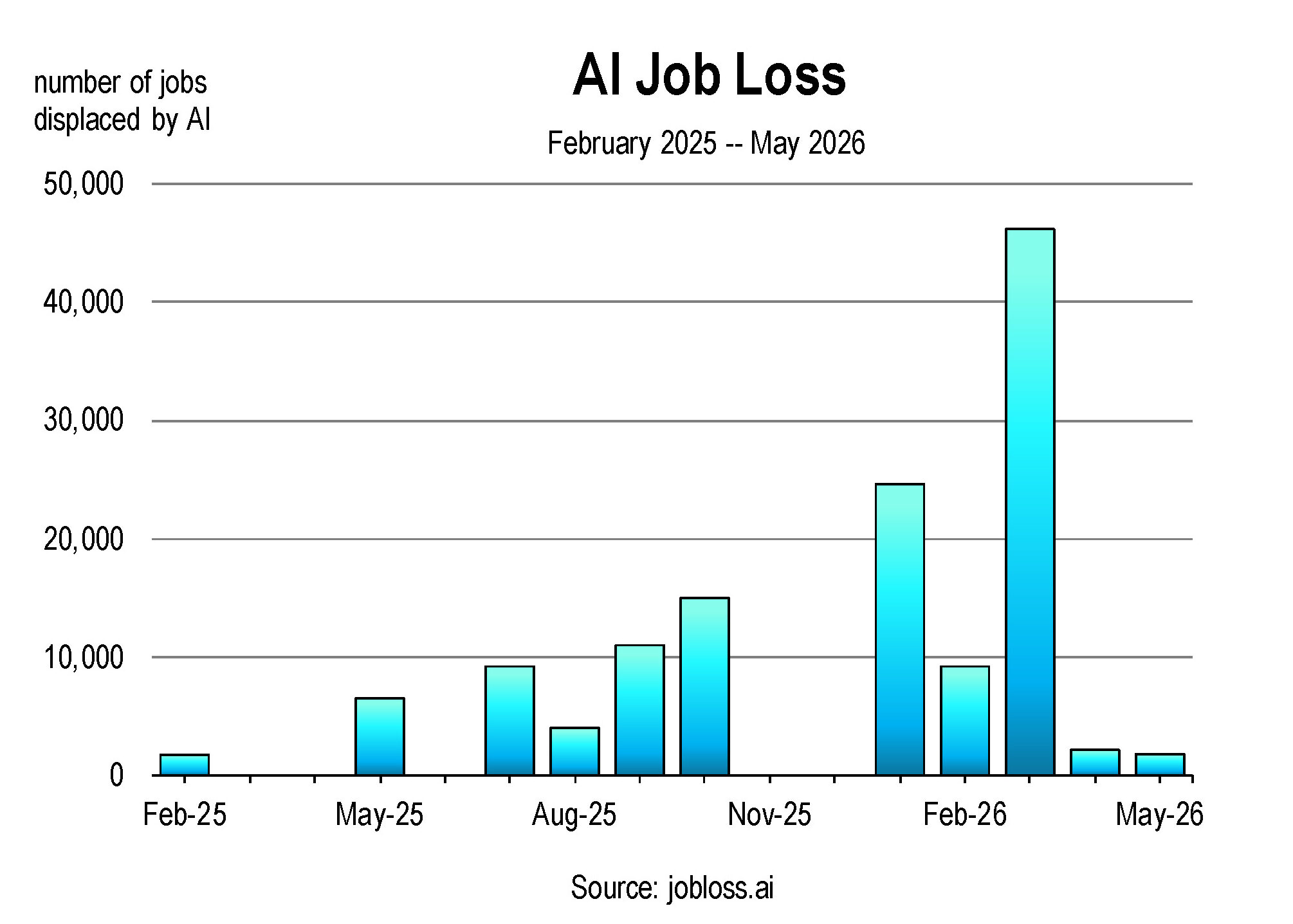 Silicon Valley and the San Francisco Bay Area — reflect ongoing restructuring as major companies accelerate AI adoption and automation initiatives. Amazon, Meta, Block, Workday, and C3.ai have been among the largest contributors to the year-to-date total, collectively accounting for nearly 70 percent of all recorded eliminations through February 28.[14]
The AI job-loss tracker jobloss.ai compiles and displays reported job cuts in the U.S. where employers explicitly cite AI or automation as the cause. For each event, they record the number of positions eliminated and attribute those to AI‑related displacement when it is explicitly mentioned, then add them to the cumulative total. Since early 2025 to date, there is a reported total of 184,000 jobs displaced by AI.
[1] “Estimating AI productivity gains from Claude conversations,” Antropic, November 25, 2025, https://www.anthropic.com/research/estimating-productivity-gains
[2] The 2025 AI Index Report, Stanford University HAI, https://hai.stanford.edu/ai-index/2025-ai-index-report
[3] Yıldız, Güney, “AI Productivity’s $4 Trillion Question: Hype, Hope, And Hard Data”, Forbes, January 20, 2026, https://www.forbes.com/sites/guneyyildiz/2026/01/20/ai-productivitys-4-trillion-question-hype-hope-and-hard-data/
[4] Liu, Jennifer, “Stanford and MIT study: A.I. boosted worker productivity by 14%—those who use it ‘will replace those who don’t’”, CNBC, April 25, 2023, https://www.cnbc.com/2023/04/25/stanford-and-mit-study-ai-boosted-worker-productivity-by-14percent.html
[5] “AI Productivity Statistics 2026”, TaskROI, March 2026, https://taskroi.com/stats
[6] AI, Productivity, and Labor Markets: A Review of the Empirical Evidence, by Eric Fruits and Kristian Stout, International Center for Law & Economics, February 2026. https://laweconcenter.org/resources/ai-productivity-and-labor-markets-a-review-of-the-empirical-evidence/
[7] Yıldız, Güney, “AI Productivity’s $4 Trillion Question: Hype, Hope, And Hard Data”, Forbes, January 20, 2026, https://www.forbes.com/sites/guneyyildiz/2026/01/20/ai-productivitys-4-trillion-question-hype-hope-and-hard-data/
[8] Cui et al. “Restoring Trust with Heart—Renqing, Relational Norms, and Cultural Intelligence in B2B Marketing”, American Marketing Association, 2025, https://doi.org/10.1177/1069031X251363727
[9] Yıldız, Güney, “AI Productivity’s $4 Trillion Question: Hype, Hope, And Hard Data”, Forbes, January 20, 2026, https://www.forbes.com/sites/guneyyildiz/2026/01/20/ai-productivitys-4-trillion-question-hype-hope-and-hard-data/
[10] “AI at Work, Quantified,” The Batch, May 8, 2026
[11] “Indicators: Artificial Intelligence”, Gallup, February 2026, https://www.gallup.com/699797/indicator-artificial-intelligence.aspx
[12] “Brynjolfsson, Erik, et. Al., “Canaries in the Coal Mine” Six Facts about the Recent Empoloyment Effects of Artificial Intelligence, November 13, 2025, https://digitaleconomy.stanford.edu/app/uploads/2025/11/CanariesintheCoalMine_Nov25.pdf?utm_campaign=The%20Batch&utm_source=hs_email&utm_medium=email
[13] Boyle, Conan, “California Tech Sector Announces 26,283 Job Cuts in Early 2026 Amid AI-Driven Restructuring”, Objectwire, March 19, 2026, https://www.objectwire.org/california/california-tech-layoffs-2026-ai-restructuring-26000-job-cuts
[14] Boyle, Conan, “California Tech Sector Announces 26,283 Job Cuts in Early 2026 Amid AI-Driven Restructuring”, Objectwire, March 19, 2026, https://www.objectwire.org/california/california-tech-layoffs-2026-ai-restructuring-26000-job-cuts
The California Economic Forecast is an economic consulting firm that produces commentary and analysis on the U.S. and California economies. The firm specializes in economic forecasts and economic impact studies, and is available to make timely, compelling, informative and entertaining economic presentations to large or small groups.